
George Russell's 60-place penalty was a cumulative sanction for six power-unit component changes, not an instruction to find a 66th grid slot. The 2026 Singapore Grand Prix had 22 entrants. Russell ultimately started 19th, last among the cars on the grid, with three other drivers starting from the pit lane.
The number looked absurd because two different systems were being compressed into one headline: a component-by-component penalty ledger and the rules that construct the actual starting order. His early 40-place sanction was already large enough to place him in the rear group. A further 20 places changed the recorded total without creating additional physical positions behind him.
This guide uses the final October 11 grid and the current FIA regulations checked on October 30. It explains the six-component ledger, the more-than-15-place threshold, why qualifying still mattered and why the unused numerical difference did not become a debt for the next Grand Prix. The race results and starting-order records are the place to verify the final outcome rather than relying on an earlier provisional-grid headline.
How Russell accumulated a 60-place penalty
The first FIA decision, Document 20 on October 9, recorded Russell using his fifth internal combustion engine, fifth turbocharger, fifth exhaust set and fourth MGU-K. Each attracted ten grid places, for 40 in total. The decision already directed officials to the rule used for drivers with more than 15 cumulative grid-place penalties.
Document 79, issued on October 11, added his fourth energy store and fourth power-unit control-electronics unit. Those two changes each added ten, bringing the ledger to 60. The later notice was an additional sanction rather than a replacement for the earlier one. That is the entire arithmetic behind the headline: four ten-place penalties followed by two more.
| Component introduced | Unit number | Penalty |
|---|---|---|
| Internal combustion engine | Fifth | 10 places |
| Turbocharger | Fifth | 10 places |
| Exhaust set | Fifth | 10 places |
| MGU-K | Fourth | 10 places |
| Energy store | Fourth | 10 places |
| Control electronics | Fourth | 10 places |
These were component-allocation penalties. They were not a single 60-place punishment for poor driving or for Russell's Singapore Sprint accident. The initial 40-place decision predated that accident, and Mercedes had already explained that a power-unit failure at the previous round made a replacement unavoidable. The Sprint crash complicated the weekend, but it cannot be used as the sole explanation for a sanction already announced.
Both notices specified the next Race in which he participated. In the regulations, the Grand Prix Race and the Sprint are separate sessions. The component sanction affected Sunday's starting order, rather than being split between Saturday and Sunday. A viewer watching Russell start near the front in the Sprint therefore was not seeing the FIA forget a penalty.
The ledger also preserves the exact element history. Saying only that he changed an engine hides the distinction between the combustion engine, electrical system and other regulated elements. Our qualifying and grid-penalty guide explains the broader separation between a timed result and a final starting position; Russell's case shows why that separation matters.
Why power-unit replacements carry grid penalties
The component pool is an endurance constraint across the season. A team can replace a failed element to keep racing, but using an extra regulated unit can still trigger a sporting consequence. The system therefore distinguishes permission to fit a part from permission to use unlimited new parts without penalty. A genuine failure can explain why Mercedes needed the change without automatically cancelling the allocation rule.
That can feel like a second punishment to a driver who has already lost a likely result. Russell's previous retirement cost points immediately; the replacement then compromised the next starting position. The frustration is understandable. However, an automatic exemption for every failed unit would also remove much of the incentive to achieve the required service life. This is the sporting tradeoff the quota creates, rather than a finding that Russell personally caused a technical failure.
The extra 2026 allowance matters
The current rules must be read with their additional 2026 allowance. For the six types relevant here, the effective season allocation is four combustion engines, four turbochargers, four exhaust sets, three energy stores, three control-electronics units and three MGU-Ks. This is why the fifth engine and fourth energy store were each the first excess unit of their respective type. Reading only the baseline table would give the wrong interpretation.
The first excess element of each type attracts ten places; subsequent additional elements of that type attract five. There is no universal rule that every component change costs ten, and fitting a previously introduced legal element from the pool is different from introducing another new one. Likewise, a fifth physical engine is not necessarily a fifth design upgrade. Unit usage and the homologated specification answer different questions.
The FIA records usage when the car leaves the pit lane as detected by its timing transponder. Consequently, the allocation problem is not confined to elements first used in the Grand Prix itself. A component introduced during another session can generate a sanction for the Race. The most reliable way to follow the story is to read the declared element number, the applicable allocation and the decision together, rather than infer the penalty from a photograph of mechanics working on the car.
How the grid turns 60 places into 19th
Russell qualified sixth with a 1:31.747. Simply adding 60 produces 66, but the grid-construction procedure does not stop at that arithmetic. It sorts different categories of drivers, places them in order and fills available positions. The penalty total determines which part of that procedure applies.
More than 15 places changes the procedure
Under Article B2.5.4, classified drivers with 15 or fewer cumulative unserved grid-place penalties go through a temporary-position calculation. Classified drivers with more than 15 are placed behind the other classified drivers, with their relative order decided by qualifying. The threshold is more than 15; exactly 15 belongs to the earlier calculation.
A hypothetical driver qualifying fifth with a 20-place sanction and another qualifying tenth with a 60-place sanction are both in that rear classified group. Their order within it comes from fifth versus tenth in qualifying, not from sorting 20 against 60. That example is why a qualifying lap can still matter after a large engine penalty. It also shows why the phrase back of the grid is useful shorthand but incomplete when several cars are affected.
Pit-lane starters are a separate group
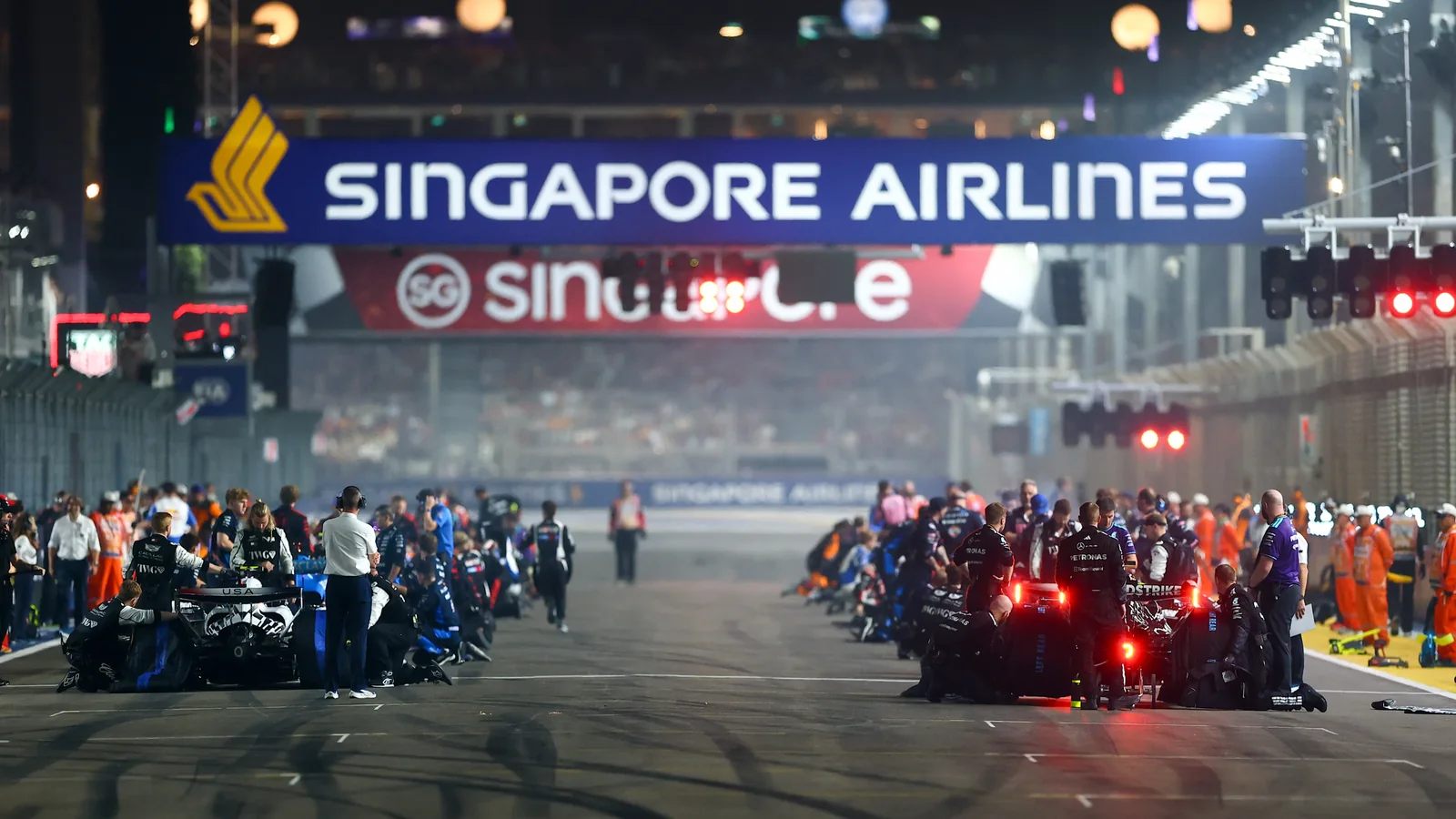
In Singapore, Fernando Alonso, Lance Stroll and Isack Hadjar were required to start from the pit lane following car modifications under parc ferme conditions. The final official note also records additional power-unit elements for Alonso and Hadjar. Those three were not occupying ordinary launch positions on the grid. Russell was therefore last among 19 grid starters while the total entry remained 22.
The official starting-order page lists Russell in 19th and explains the three pit-lane starts in its note. Earlier reports describing him as 22nd were overtaken by those changes. They need to be read as an earlier expectation, rather than as evidence that three places of his sanction vanished through an appeal. The engine penalties remained recorded as 60.
Pit-lane starts also have their own release procedure, so a printed list of entrants should not be mistaken for 22 cars physically lined up in 22 boxes. Russell could be last on the grid while other competitors began behind the departing field from a different location. For a full weekend, compare qualifying classification and the final grid as two connected records, not two versions of the same table.
Does the unused penalty carry into the next race?
No leftover numerical balance was created by Russell starting 19th. The sanction was applied through the prescribed starting-order procedure at Singapore. It was not a 60-position debt from which officials subtracted the 13 positions between his sixth-place qualifying result and 19th-place start. Such subtraction would manufacture a 47-place balance that the grid rules do not create.
The practical distinction is between an applied sanction and an unserved one. The notices refer to the next Race in which the driver participates. That wording matters if the next event never becomes the race at which a sanction can be applied; it does not mean a large sanction can only be completed by physically moving down every named position. The rear-group procedure exists precisely because some totals exceed the available grid.
Russell still retained the component-usage history. Serving a grid penalty does not reset his season allocation to zero. If Mercedes later introduced another excess element, the new use could attract its own penalty under the applicable rule. Reusing an element already validly introduced is a different situation. This is why future engine stories must be checked against the element pool rather than against an imaginary remainder from the Singapore headline.
There is no automatic conversion into race time either. Officials did not turn the absent grid positions into seconds, laps or championship-point deductions. Those sanctions belong to different provisions and decisions. The recorded 60-place total can remain in the historical note while the practical consequence is last among the grid starters.
For viewers, the simplest verification is the next event's actual penalty decisions and final grid. If another notice appears, read its stated offense and element number; do not assume it is a delayed installment of the old sanction. The current weekend schedule helps locate when the relevant qualifying and pre-race updates will arrive, but only the final sporting documents establish what has actually been applied.
Why teams sometimes add more components at once
Once a driver is already in the rear classified group, another component penalty may have little additional effect on that day's grid position. Introducing a fresh energy store alongside a fresh engine can therefore be attractive compared with taking a separate grid setback later. That is an incentive created by the procedure, not proof of a secret Mercedes strategy or of an attempt to mislead officials.
There are still real constraints. Components must exist, satisfy the approved specification, be fitted and checked, and serve the team's reliability needs. A lower immediate grid cost does not make development, hardware or installation work free. Replacing a part unnecessarily can also consume resources or disrupt preparation. The final decision depends on engineering information the public does not possess.
The rule that limits repeated stockpiling
The rules specifically address introducing more than one penalized element of the same type during a single competition. Only the last element fitted may be used at subsequent competitions without a further penalty. This prevents the simple idea of running several new excess engines briefly in one weekend and then using all of them later as a penalty-free stockpile.
That restriction concerns repeated elements of the same type. It should not be confused with Russell's six different types in the penalty ledger. An engine, turbocharger and energy store are separate regulated categories; taking one of each is not identical to introducing several engines. The distinction explains why a large cumulative number can reflect a broad replacement package without establishing that Mercedes acquired unlimited future engines.
Nor does a newly introduced unit automatically prove a performance upgrade was installed. Reliability replacement, development eligibility, approved specification and physical element usage are related but separate records. The October 7 F1 report said Russell's failure brought an expected replacement forward; it did not establish that every hoped-for later development was ready for Singapore. Our Mercedes W17 guide provides the broader car context without turning the penalty notice into an upgrade announcement.
The sensible fan question is therefore which parts entered the usable pool and what future flexibility that creates, rather than whether an extra ten places sounds sufficiently severe. The penalty system regulates use over a season, while the starting-order procedure governs one race. Much of the apparent loophole comes from mixing those two time horizons.
What the penalty actually cost Russell in Singapore
Russell recovered from 19th on the grid to ninth in the race, earning two points. That was useful damage limitation, but it should not disguise the scale of the lost opportunity created by starting behind the field. A driver who qualified sixth had to spend the race recovering track position before he could fight for a normal share of points.
The ten-place difference between start and finish is not a verified count of ten on-track overtakes. Pit-lane starters, retirements, pit cycles and actual passes all influence positional changes. Race footage and timing are needed to count specific overtakes. The final classification tells us the outcome without proving the precise route by which every position was gained.
Russell's published post-race account also described the difficulty of turning strategy into track position. He said the Virtual Safety Car ended as he entered the pit lane, reducing the benefit of that stop, and credited Nico Hulkenberg's defense of eighth. Those details show why the starting setback mattered: traffic and strategy constrained the recovery. They do not justify inventing a precise finishing position he would have achieved from sixth.
Antonelli finished third with 15 points, so Russell lost another 13 points to his teammate in the Grand Prix itself. The penalty contributed to the circumstances, while the season's reliability and performance problems created the larger championship context. It would be too strong to attribute that entire points difference solely to the final additional 20 places, which did not change his rear-group status.
For the next large penalty headline, check four items in order: the element ledger, the qualifying classification, the grid-construction category and the final pit-lane or withdrawal notices. Then consult the race classification and championship standings for the consequence. This sequence explains how a sanction larger than the field can be real, correctly applied and still produce a seemingly modest printed starting position.
Singapore's final answer is specific: 40 plus 20 produced a 60-place recorded penalty; the more-than-15 rule put Russell in the rear classified group; three pit-lane starters left him 19th on the physical grid. No fictional extra positions and no leftover numerical debt are needed to explain it.
Loading comments…