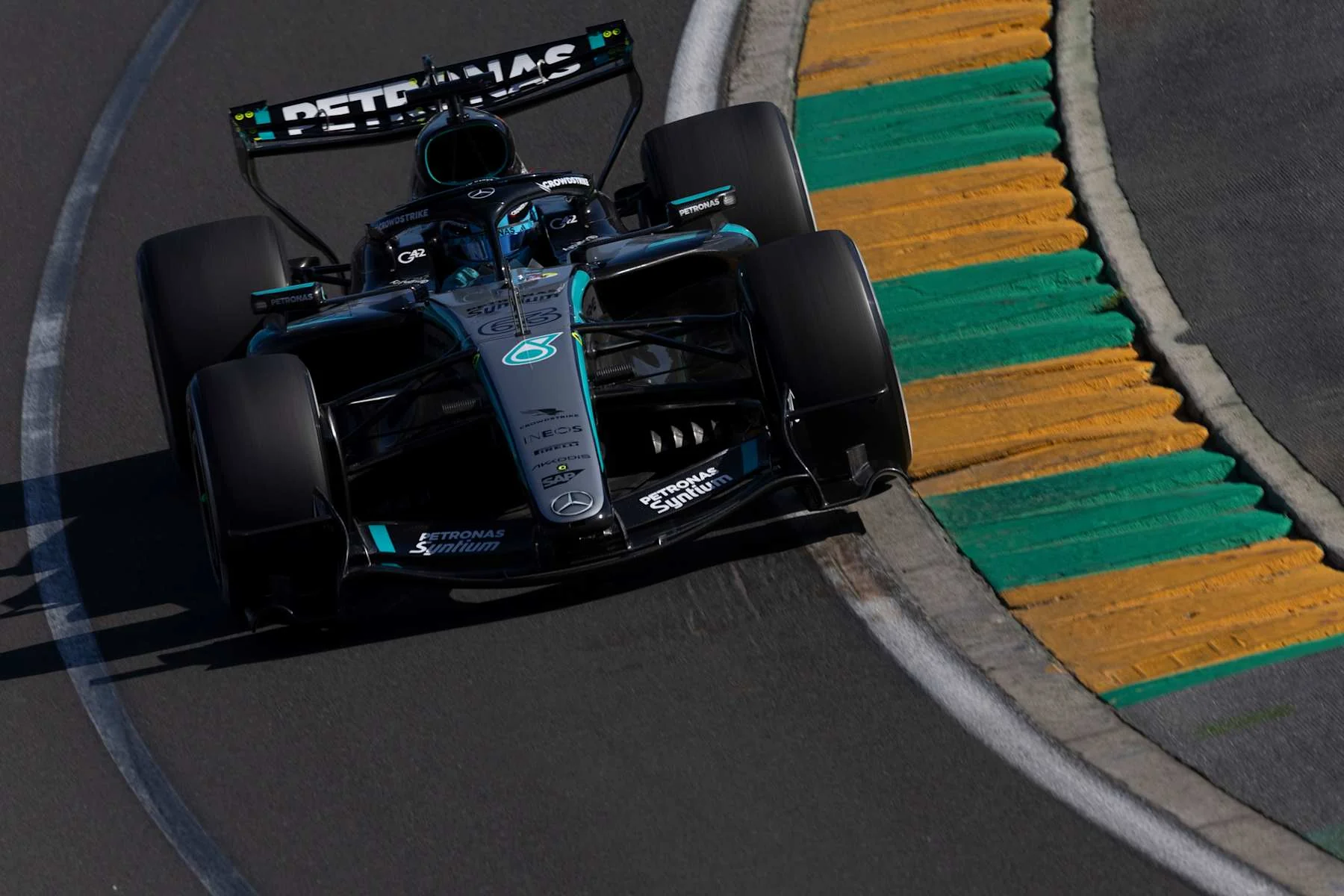
The Mercedes-AMG F1 W17 is the team's 2026 Formula 1 car, built for a rule change that reshaped the chassis, aerodynamics and hybrid power unit at the same time. Its published specification gives useful hard numbers, including a 1.6-litre V6, a 350 kW electric motor-generator and a 1,900 mm overall width. Those figures explain the design problem; they do not reveal every development part fitted to a car racing months after its launch.
As of September 30, 2026, George Russell and Kimi Antonelli have already put the W17 through a substantial stretch of the season. This guide separates what Mercedes and the FIA have documented from what can only be inferred from photographs or lap times. It explains the bodywork, suspension and power unit in plain language, then uses official race results to show what the car has achieved so far. Readers can use the F1 schedule to follow the remaining 2026 rounds.
What is the Mercedes W17?
The full name is the Mercedes-AMG F1 W17 E PERFORMANCE. It is the Mercedes works team's 2026 single-seater, driven by George Russell and Kimi Antonelli. The W17 replaces the previous season's car at the point where Formula 1 changed both its car rules and its hybrid power-unit rules. That is why its shape, dimensions and energy strategy need more explanation than a routine annual livery change. Mercedes published the first W17 images on January 22, then held its season launch on February 2, before the car's early track work developed into a full racing campaign.
Those January images were computer renders. They showed the visual identity and an intended design direction, but a render cannot prove every aerodynamic surface that will appear at a Grand Prix months later. Mercedes' actual car ran in a Barcelona shakedown; the team reported 500 laps and more than 2,325 km across its three days there. That mileage demonstrated a car capable of running a testing programme, while the team still had to learn how it behaved in different temperatures, on different tyres and at race pace. The later Bahrain test and competitive weekends were more meaningful checks of the complete package.
Mercedes' published W17 specification describes a carbon-fibre and honeycomb composite monocoque, carbon-fibre bodywork, an eight-speed gearbox and the Mercedes-AMG F1 M17 E PERFORMANCE power unit. It lists the car at 1,900 mm wide, under 5,505 mm long and 970 mm high, with an overall weight of 772 kg. These are the team's published figures for its car, not a claim that every race setup weighs exactly 772 kg or that the regulation minimum has the same value. Fuel load, component choices and technical declarations all need their own context.
The familiar silver, black and turquoise colours make the W17 instantly recognizable, but paint does not tell you how it generates lap time. Its actual job is to make a smaller, narrower car work with a lower-downforce floor, movable wings and a much more important electrical part of the hybrid system. The team had to balance cooling, drag, cornering stability, tyre use, deployment and reliability. The following sections explain the parts Mercedes has documented and the design choices that can be observed without treating a photograph as a wind-tunnel report.
How does the W17 chassis use the 2026 rules?
The W17 sits inside a different design envelope from the previous generation. Formula 1's 2026 rules make the cars narrower and shorten the permitted wheelbase, while a partly flat floor and a less powerful diffuser reduce reliance on the deep ground-effect tunnels used before. Mercedes lists its W17 at 1,900 mm wide. A smaller body does not automatically mean a quicker car: the team still needs a predictable balance as ride height, speed and steering angle change. The front wing, floor, sidepods, cooling exits and rear wing all influence the quality of airflow delivered to the next part.
Front suspension, nose and floor
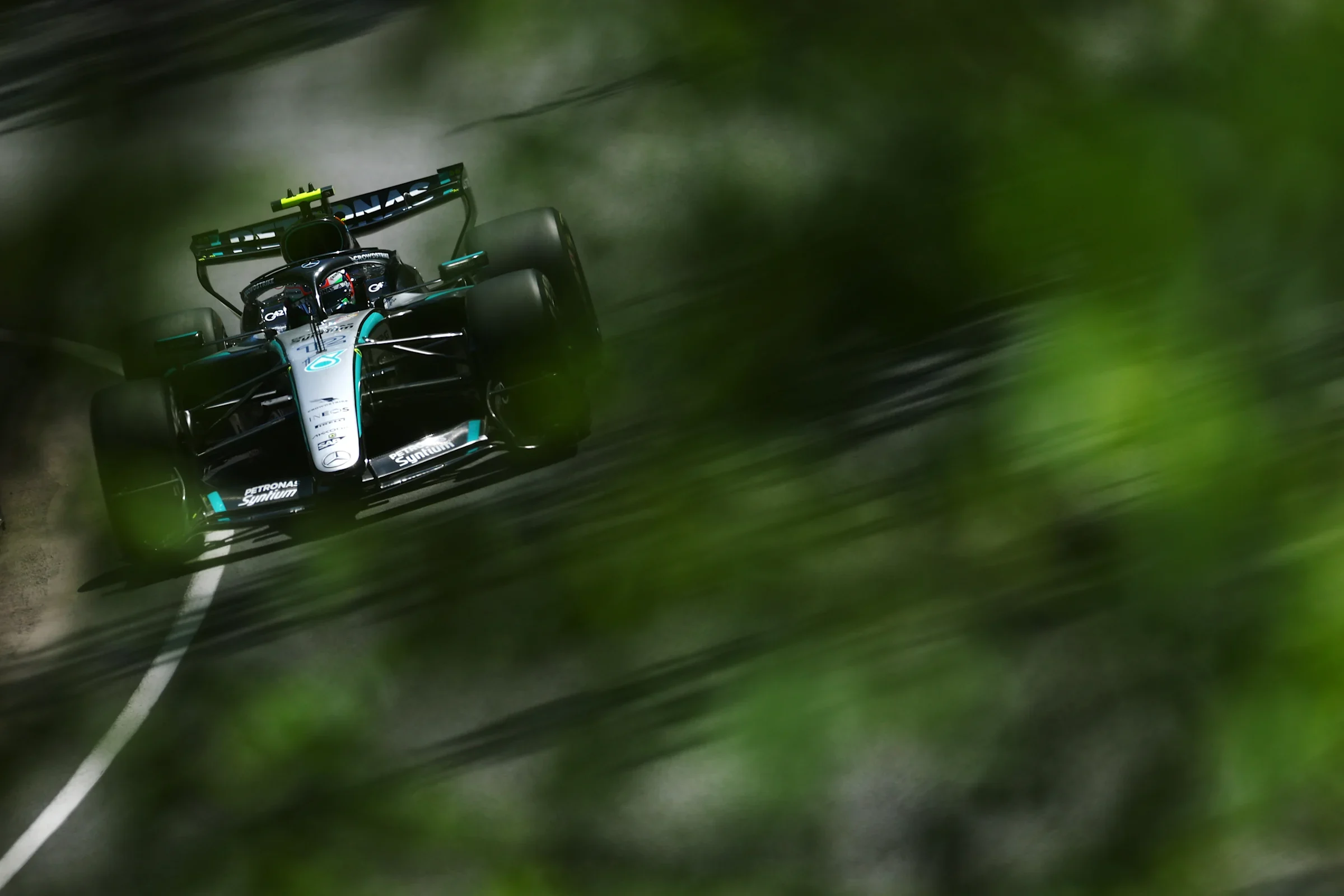
Mercedes' published chassis specification confirms pushrod-activated front and rear suspension, with carbon-fibre wishbones. The suspension is not simply a visible pair of arms: it controls the platform that the wings and floor need to work. When a car brakes, turns or rides a kerb, its height and attitude change; a stable, usable aerodynamic balance helps the driver trust the car through all of those phases. A pushrod layout has packaging and weight implications, but the team's public specification does not disclose a complete setup or prove that this layout alone explains its results.
Formula 1's January technical look at the launch images noted how the displayed nose joined the front wing, along with distinctive rear bodywork and in-wash floor-board details. The analyst also warned that the images were renders. That warning matters in September: an early render is evidence of what Mercedes chose to show, not a measured drawing of every surface on the current race car. A real update was documented later when F1's Canadian Grand Prix technical report described a revised Mercedes front wing, extra strakes and rearranged floor slots. That is a more concrete example of the car being developed after launch.
The newer floor rules reduce the downforce that teams could previously extract from venturi tunnels, so how the front of the car manages tyre wake and feeds the floor remains important. The nose and wing affect the air approaching the front tyres; the floor and sidepod region then shape what reaches the diffuser and rear wing. It is reasonable to infer that a team updating those surfaces is seeking a better performance balance. It would be speculative to assign a precise lap-time gain or declare the W17's private airflow map from photographs alone.
Active wings and the lower-drag concept
The biggest visible regulation change is that both front and rear wing elements can change position. In Corner Mode, they are set for greater downforce and grip. In Straight Mode, they move to a lower-drag position so the car needs less energy to push through the air at high speed. The FIA explains that the mode is available at designated places on a circuit regardless of whether a driver is close to another car. That is different from the old DRS rule, which was principally an overtaking aid tied to following distance in a detection zone.
For the W17, the task is to make both modes useful. A low-drag straight-line configuration can preserve speed and battery energy, but the car must still enter the next corner with confidence once its wings return to the higher-downforce position. Wing movement, floor loading and tyre grip therefore interact with power-unit deployment. When watching onboard footage, notice where the active surfaces change and how the car behaves under braking; a top-speed figure on its own misses the compromise. The active wing system also should not be confused with the separate electrical boost and override provisions that affect acceleration and overtaking.
What powers the W17?
Mercedes calls the W17's power unit the Mercedes-AMG F1 M17 E PERFORMANCE. Its published technical sheet specifies a 1.6-litre, 90-degree V6 internal-combustion engine, a turbocharger, a motor-generator unit connected to the drivetrain, an energy store and control electronics. The MGU-K can deliver a maximum electrical power of 350 kW according to that sheet. The old heat motor-generator, or MGU-H, is absent under the 2026 rules. This makes energy recovered under braking and the timing of its deployment more central to driving and strategy.
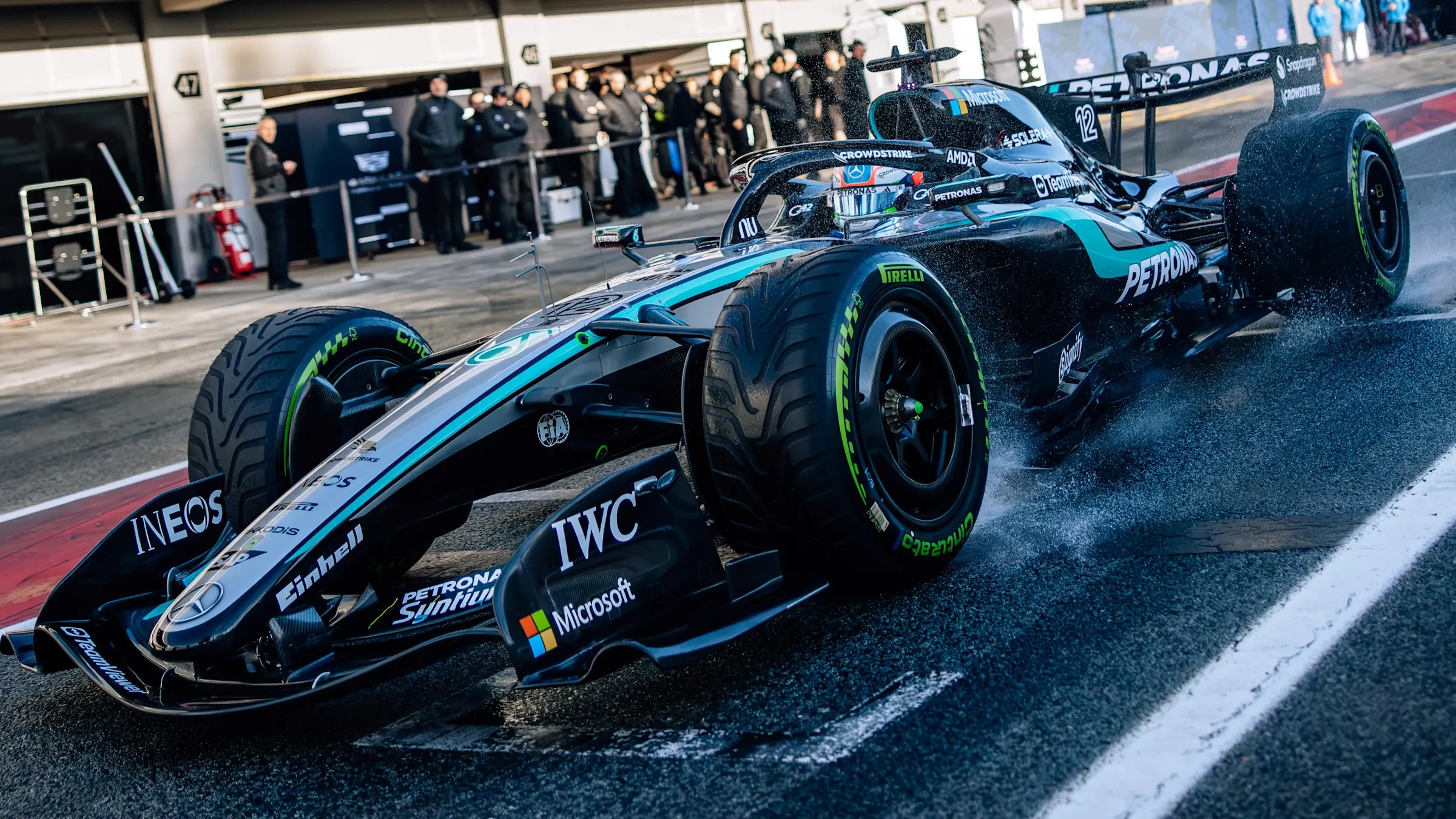
The team lists a lithium-ion battery solution with a maximum usable on-track storage range of 4.0 MJ. Its specification also gives a circuit-specific maximum MGU-K recovery figure of 9.0 MJ per lap. These numbers describe separate things: one is usable stored energy; the other is a possible recovery allowance across a lap under relevant conditions. Neither says that the battery is full at every corner or that 350 kW can be applied continuously around an entire lap. In a race, the driver and control systems must manage finite energy while meeting sporting and technical limits.
Fuel is another part of the reset. Mercedes specifies PETRONAS Primax for the W17 and PETRONAS Syntium lubricants. The FIA's 2026 framework requires advanced sustainable fuel, while retaining a 1.6-litre V6 architecture. The fuel and engine are developed as a system: combustion efficiency, cooling, packaging and reliability all affect the amount of performance available across a Grand Prix distance. A headline comparison of electric and combustion power does not reveal Mercedes' private calibration or the thermal limits of its actual race installation.
Why electrical deployment matters on track
Think of a lap as a sequence of energy decisions. Braking zones create opportunities to recover energy; corner exits reward well-timed electrical assistance; straights consume it quickly. A low-drag wing position can reduce the energy needed to hold speed, but it cannot refill the battery by itself. A driver who uses too much electrical power early on a long straight may have less available at the end or at the next acceleration point. Those tradeoffs can affect both a qualifying lap and a fight with another car, even when the hardware is unchanged.
The FIA refined these rules after observing the opening 2026 races. Its April statement retained 350 kW MGU-K deployment in important acceleration zones while limiting it to 250 kW in other portions of the lap, and it adjusted qualifying recharge parameters. It also addressed race boost to reduce sudden speed differences. These season changes are why an early launch claim that a car simply has “350 kW electric power everywhere” is misleading. The W17's published 350 kW figure is a component maximum; what the car may use at a given point depends on the applicable rules, energy state and conditions.
This also explains why a speed-trap reading cannot identify the strongest power unit. Wing drag, tyre choice, exit speed, battery state and selected deployment all feed into that number. To understand the W17's performance, look at how consistently it accelerates out of slower corners, sustains a run along the straight and repeats that over a stint. The public specifications give the architecture; they do not expose Mercedes' full energy map or isolate the engine from the rest of the car.
What has the 2026 season shown so far?
By September 30, fifteen Grands Prix had been completed. Mercedes' two W17 drivers have produced the strongest collective points return on the grid: the official F1 team profile shows 538 constructors' points after the Azerbaijan race. Kimi Antonelli leads the drivers' table with 302 points, while George Russell is 66 points behind on 236. F1's Azerbaijan report says Antonelli had taken eight Grand Prix wins and Russell three by then. These figures establish that the W17 has been a competitive, points-scoring car over many kinds of circuit; they do not establish that one part of its bodywork or power unit is the single reason.
The latest race is a useful illustration of both strength and limits. Russell took pole in Baku and won the September 26 Azerbaijan Grand Prix, while Antonelli finished fifth after a difficult qualifying session. Max Verstappen ended just 0.196 seconds behind Russell at the flag. The result shows a W17 able to win on a circuit with a long straight and tight city corners, but it also shows how close another car could be in that particular race. Race pace, tyre life, strategy, safety cars and driving all affected the outcome. One finish margin cannot be turned into a precise power-unit or downforce measurement.
The 2026 season has also moved far beyond the January launch. Mercedes ran extensive Barcelona shakedown mileage, had further learning to do in Bahrain testing, and brought documented aerodynamic updates during the year. The Canadian Grand Prix technical briefing, for example, recorded changes to its front wing and floor slots. A car carrying the W17 name in September is therefore a developed race machine rather than an untouched copy of the first images. The same principle applies to competitors, who also modify their cars and can be stronger at certain tracks or in particular conditions.
For a fan trying to judge its quality, repeated patterns are more informative than a single fast lap. Watch whether both drivers can qualify well, whether the car handles slow and fast corners, how tyre pace changes through a stint, and whether reliability lets the team convert speed into points. Mercedes' large points total is strong evidence of effective performance across the completed season. It is still too early to call a championship decided, and the standings will move when the remaining races are run. A dated result snapshot belongs alongside the car's technical explanation, not in place of it.
How should fans judge future W17 upgrades?
Start with a specific, dated component change. Teams file car-presentation information with the FIA for a Grand Prix, describing what has changed and the intended reason. Mercedes' Australian submission said its early R01 bodywork had a more downwash-oriented shape than its 2026 starting point. Its Canadian submission later described front-wing and footplate changes intended to make airflow toward the rear of the car more robust. Those documents are better evidence of a real development step than side-by-side launch renders, but they still describe intent. They do not publish an independently measured lap-time benefit.
Next ask where a change should help. A front wing or floor revision aimed at airflow consistency may be valuable when ride height and steering angle vary, not only on a qualifying straight. A new rear wing may trade cornering load against drag in Straight Mode. Cooling changes can improve reliability or allow a different setup without being obvious in a television shot. When the team says a part is for local load, flow conditioning or cooling, use that stated purpose to form a testable expectation; avoid assuming every new piece is a pure speed upgrade.
Then compare the results carefully. Look at both W17 drivers across practice, qualifying and race stints, and account for tyre compound, fuel load, weather, track evolution and traffic. A faster lap after an update might reflect a better setup or a circuit that already suited the car. A slower result can coexist with a useful upgrade if rivals improve more quickly or the team encounters reliability trouble. Several weekends offer a clearer pattern than one session, especially in a season where the power and aero rules themselves have been refined.
Finally, keep the clock attached to every claim. A January render, a May FIA submission and a September race photograph are snapshots of different stages. Mercedes will continue to run a W17, but the exact surfaces on it can change. Check the official race pages for verified outcomes and the team's or FIA's documentation for declared hardware changes. That method gives a more useful answer to “How good is the Mercedes F1 car in 2026?” than a single speed-trap number or a theory drawn from an image. The confirmed conclusion through Azerbaijan is a highly successful W17 campaign; its exact technical advantage at any future event remains something to test, not assume.
Loading comments…