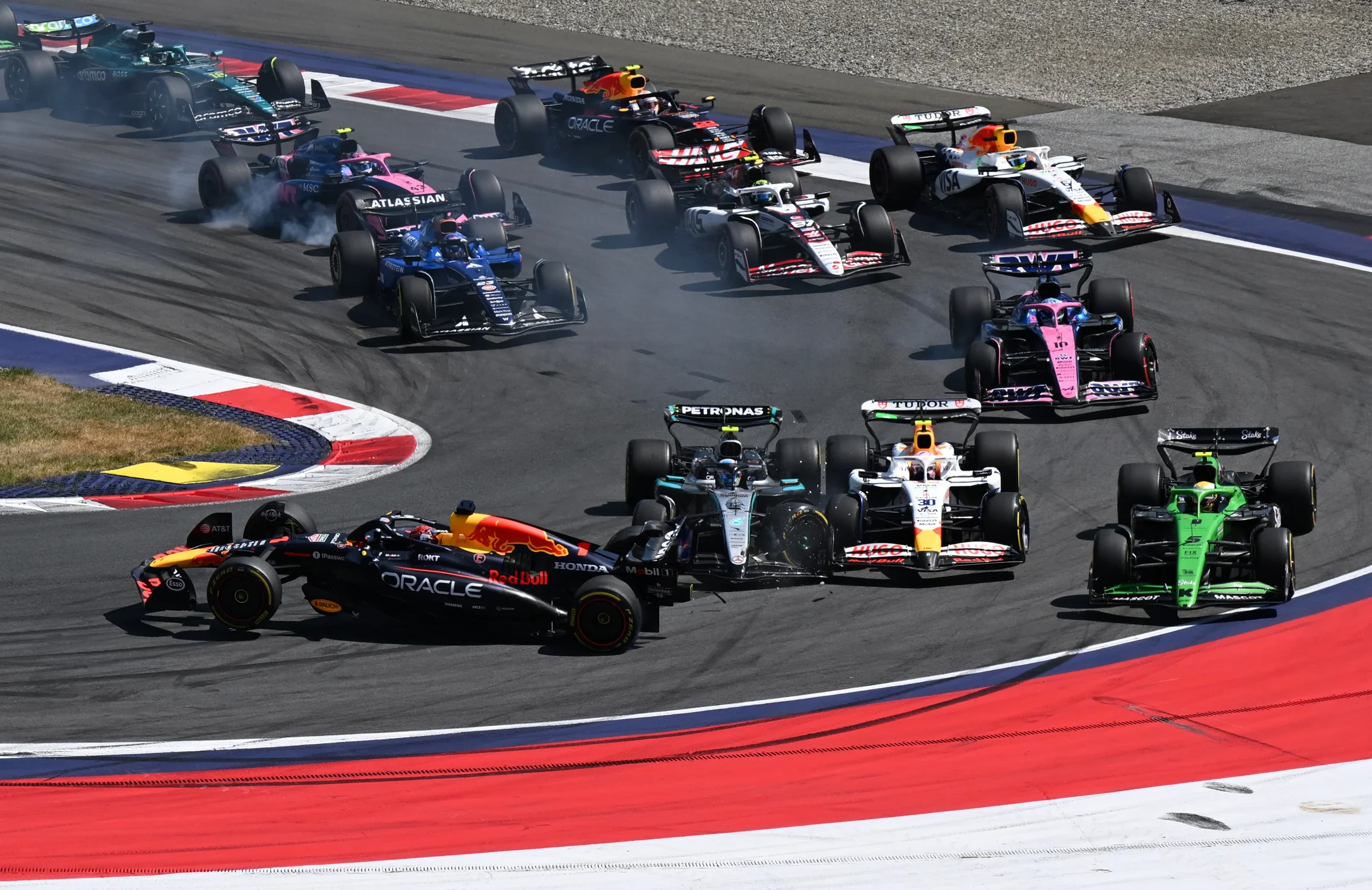
F1 penalties often look inconsistent because television reduces a legal process to two short clips and two numbers. The stewards do not begin by asking whether an incident resembles last week's highlight. They identify the alleged rule, establish facts from several forms of evidence, apply the relevant driving standard, decide responsibility and only then select a sanction. Change one ingredient—corner geometry, overlap, control, flags, session or degree of blame—and the correct comparison may change.
That does not mean every decision is beyond criticism. Formula 1 uses event-based panels, and important thresholds still require human judgment under time pressure. The FIA's 2026 Driving Standards Guidelines openly acknowledge subjectivity. But the same document also says it is guidance rather than regulation, a distinction frequently lost when a graphic or social post treats one sentence as an automatic penalty formula.
This guide reconstructs how the system actually works and shows where defensible variation ends and genuine inconsistency can begin. It separates liability from punishment, sporting penalties from licence points, and a steward's written reasons from the championship damage that follows. The governing FIA material and regulation index were checked through September 13, 2026; always use the live issue and the official event documents for a current case.
Start With the Rule Hierarchy, Not the TV Caption
A fair comparison requires the authority that was actually applied. A broadcaster may say “causing a collision” while the document finds forcing another driver off, leaving the track and gaining an advantage, impeding or a procedural breach. Those are different offences with different tests. Start from the cited article and current issue, not the shorthand.
Binding regulations and non-binding guidelines do different jobs
The rule hierarchy is less tidy than one universal penalty chart. The FIA International Sporting Code and Formula One regulations supply binding duties and powers. The 2026 Driving Standards Guidelines organize how stewards assess familiar wheel-to-wheel situations; the Penalty Guidelines indicate normal sanctions. The FIA explicitly labels both guideline documents as having no regulatory value. They promote predictability without replacing the rule cited in a decision.
That distinction preserves necessary judgment. A guideline can specify the overlap normally required for racing room, yet it cannot encode every radius, camber, speed, lock-up or avoidance move. Stewards remain responsible for applying the regulation to the actual evidence. Quoting one guideline bullet and skipping its caveats can therefore produce a confident but incomplete verdict.
Event notes and written decisions complete the record
A race weekend adds local instructions and an evidentiary record. Race-director notes can identify track-limit boundaries, pit-entry procedures or other circuit-specific details. They operate within the regulations; they are not permission to invent a new offence. The stewards' published document then identifies the case that was actually decided.
The FIA event portal can contain notes, reports, summonses, decisions and revised classifications. Monaco's 2026 page, for example, preserves a long sequence involving decisions, review petitions and later revisions. That illustrates why an on-screen “noted” message is only the start and why a five-second caption is not the reasons. Before comparing incidents, read the document's cited rule, evidence, factual finding and wording about responsibility.
Fast test
If two decisions cite different offences—or one is a mandatory technical consequence while the other is discretionary driving conduct—the matching number on the timing screen does not make them precedents for each other.
How an Incident Becomes a Stewarding Case
The stewards are the judges, not the race director and not the broadcast booth. A matter can reach them through a report, referral or their own authority. “Noted” signals attention; “investigated” signals an assessment; neither phrase establishes guilt. The process matters because a dramatic first angle may omit the information that resolves the case.

Referral, evidence and the right to be heard
When a hearing is required, the relevant driver and team are summoned and can explain what happened. The evidence may include television and onboard video, telemetry, GPS traces, timing, team radio and reports from race control or officials. Each answers a different question: video shows position, telemetry shows inputs and speed, radio may establish warnings, and timing can identify whether another car was on a push lap.
A 2026 Australian Grand Prix decision about allegedly driving unnecessarily slowly demonstrates the value of context. The stewards heard the driver and team and reviewed video. They considered a false neutral, radio instructions, the intended emergency-exit side and the approaching driver's sightline, then took no further action. The television danger was real, but the evidence did not produce the alleged infringement.
The written decision separates facts from the finding
A standard FIA decision identifies the car, session and time, describes the fact, cites the regulation, states the decision and explains the reason. That structure is an audit trail. It lets a reader distinguish an allegation from a breach and see whether the punishment attaches to the driver, the competitor or both.
The difference is practical. A Japanese Grand Prix impeding decision in 2026 recorded video, telemetry, radio and onboard evidence before issuing a driver warning. An Australian unsafe-release case recorded similar evidence but fined the team. Calling both “penalties” hides who breached which duty and what sanction category applied. Read the reason paragraph before comparing the number.
- 01
Establish evidence
Position, inputs, warnings and session state.
- 02
Find the breach
Apply the cited rule and relevant guidance.
- 03
Select sanction
Use the baseline and case circumstances.
Racing-Room Tests Depend on Corner Geometry
Wheel-to-wheel decisions generate the loudest inconsistency claims because viewers can place two apex screenshots side by side. Yet the 2026 guidance asks several linked questions across corner entry, apex and exit. Which car attacked, on which side, with what overlap, under what control and on what plausible racing line all matter.
Inside and outside overtakes use different thresholds
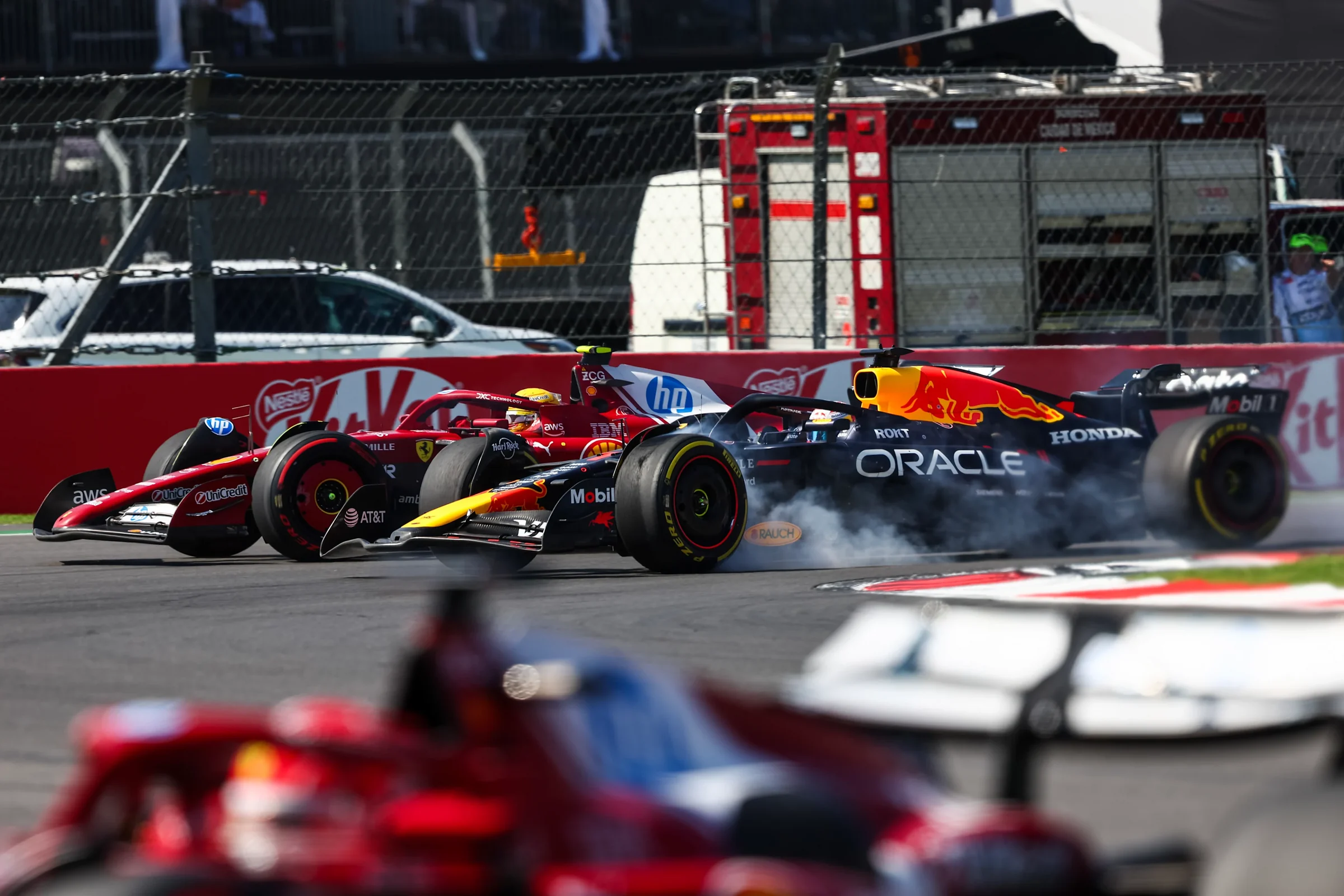
For an inside pass, the FIA guideline looks for the attacking car's front axle to be at least alongside the other car's mirror before and at the apex. The car must also be controlled, avoid a dive-in and be capable of completing a reasonable line inside track limits. Passing one overlap marker is not enough if the car arrives too fast to make the corner.
An outside pass faces a higher positioning threshold: the attacker's front axle should be ahead of the other car's front axle at the apex, with control from entry through exit and the ability to stay within limits. Once an overtaker earns priority under the applicable test, the defender must avoid contact or forcing that car off. A clip with “half a car alongside” can therefore mean different things on the inside and outside.
Track limits and contact do not decide blame by themselves
Contact is important, but it is not a strict-liability switch. A car can make the final touch after being crowded; another can avoid contact only by leaving the road. Stewards reconstruct how the available space disappeared and whether either driver had earned room. The guidelines also warn that a lock-up or small correction does not necessarily prove loss of control, and apparent instability may reflect avoidance.
Track limits add another layer. Crossing the line may defeat an overtaker's claim that the move was completable, establish an advantage, or be the consequence of being forced off. Those possibilities invoke different reasoning. The corner's apex itself can vary with line and shape, so a graphic drawn around one frame should not substitute for the full onboard sequence and data.
| Question | Why it changes the case |
|---|---|
| Inside or outside? | The overlap threshold is different. |
| Controlled and completable? | Position alone does not earn room. |
| Why did a car leave? | Error, avoidance and being forced off are not equivalent. |
Liability and Sanction Are Separate Questions
Many arguments jump from contact directly to “five or ten seconds?” Stewards should first decide whether an infringement occurred and identify responsibility. In a collision case that can mean judging whether one driver was predominantly responsible rather than treating every racing touch as punishable. Other offences are more binary: speeding in the pit lane, ignoring a flag or failing a technical requirement can turn on a measurement or defined duty.
Only after that finding does sanction selection begin. The Penalty Guidelines connect offence categories and session contexts to usual starting points; mandatory regulation wording can remove discretion. Keeping these stages separate explains why “there was contact” does not guarantee a penalty and why two guilty findings can produce different forms of punishment.
Race impact is a particularly misleading comparison. Five seconds added to a driver with a large gap may change nothing. Five seconds in a tightly packed field can drop the same driver several places. That difference can feel unfair, but tailoring every sanction to final-position damage would make the rule depend on rivals' pace, pit strategy and safety-car timing. The disciplinary unit is normally the conduct, not a guaranteed amount of championship pain.
Consequences are not always irrelevant. Some provisions or guidelines explicitly distinguish conduct by danger, result or session, and a serious outcome may be evidence of gravity. The point is narrower: never infer calibration solely from the finishing order. Read the reasons first, then inspect the updated F1 results and championship standings to measure competitive consequence.
Two equal sanctions can create unequal race damage without proving that the stewarding standard changed.
Why the Guideline Starting Point Can Move
A guideline promotes consistency by giving stewards a shared starting point, not by making every row a vending-machine button. The 2026 matrix distinguishes offence, session and licence points, flags mandatory outcomes where applicable, and sometimes states a range or alternative for materially different circumstances.
Offence type and session context set the baseline
The same conduct cannot always use the same sanction instrument. A race time penalty can be served or added to elapsed time; in practice there is no finishing time to adjust, while impeding in qualifying can damage another driver's only quick lap. Grid drops, lap deletions, reprimands, fines and pit-lane starts solve different sporting problems.
For illustration, the 2026 guideline lists ten seconds as the race baseline for causing a collision, but it allows five seconds in mitigating circumstances and a range of outcomes when contact has no immediate and obvious sporting consequence. Practice and qualifying columns differ. Those are published guideposts; the cited regulation and current document still control.
Mitigating, aggravating and repeat conduct alter the case
Mitigation can include facts that reduce culpability or gravity: meaningful avoidance, shared contribution, a minor touch or an unusual circumstance supported by evidence. Aggravation can arise from danger, recklessness, apparent deliberateness, repetition or disregarded instructions when the applicable framework makes those facts relevant. This is not a universal checklist; the reason must connect the circumstance to the offence.
Repeat mechanisms also explain apparent jumps. An isolated error and a trigger based on accumulated reprimands are legally different even if the latest act looks modest. Conversely, a famous driver does not receive an aggravation merely because social media remembers previous controversies. The relevant history must be one the regulation or guideline authorizes the stewards to use.
Licence penalty points answer a different safety question
Super-licence penalty points sit beside, not inside, the immediate sporting sanction. The 2026 driving guidance says points for driving incidents should generally be reserved for dangerous, reckless, apparently deliberate, otherwise unacceptable or unsportsmanlike behaviour. Asterisked figures in the penalty matrix are maximum guidance, allowing zero up to that number.
That is why a driver can receive a time penalty with no licence points, or receive more points when similar sporting punishment reflects a more dangerous act. Licence points track conduct toward a suspension mechanism; they do not compensate the victim or mirror places lost.
| Layer | Question answered | Typical output |
|---|---|---|
| Liability | Was the rule breached? | No action or infringement finding |
| Sporting sanction | What restores discipline in this session? | Time, grid, deletion, reprimand or fine |
| Licence points | Does the driving merit a safety record? | Zero up to the guideline maximum |
Where Genuine Inconsistency Can Enter
Context explains many different outcomes, but it should not become a slogan that excuses everything. Formula 1 still asks humans to estimate control, available room, danger and responsibility from imperfect evidence. Borderline calls can move even when everyone acts honestly.
Rotating panels bring experience but also judgment variance
Stewards are appointed for events rather than sitting as one immutable season-long bench, and FIA event records can document substitutions. Panels include specialist officials and driver experience; the FIA and drivers have stressed the value of an experienced Driver Steward because written guidance cannot cover every scenario. That expertise improves the factual discussion but does not erase individual judgment.
Shared guidelines, decision templates, reviews of prior incidents and professional development create a common language. Still, one panel may see a marginal overlap as established while another views the same-looking position as too late once speed and line are considered. A meaningful consistency audit asks whether the reasons identify the same factors and apply comparable thresholds—not whether different names appeared on the document.
Previous decisions inform comparison without becoming a template
F1 decisions provide useful comparators, but this is not a rigid common-law precedent system. The FIA says its International Court of Appeal may consider earlier rulings yet is not legally bound by them; each case is decided on its merits. Event stewards likewise reason from the applicable rule, guidance and evidence, sometimes noting analogous treatment when no exact precedent exists.
That makes past decisions evidence of expected practice, not a copy-and-paste sentence. A strong comparison matches the cited article, offence wording, session, overlap, control, consequence category and responsibility finding. If only the drivers and time penalty match, the comparison is weak. If all legal ingredients match and the reasons diverge without explanation, the inconsistency criticism becomes much stronger.
A defensible criticism is specific.
Say which established fact or guideline factor was treated differently. “They gave someone else five seconds” is an outcome comparison; it does not yet demonstrate unequal application.
A Better Way to Audit a Controversial Penalty
You do not need access to race control to make a disciplined assessment. You do need the actual decision and a method that resists highlight bias. Use this sequence after the FIA publishes the event document; before then, label conclusions provisional.
1. Download the exact decision.
Record car, lap or time, session, alleged fact, final finding and sanction. “Noted” and “investigated” are not verdicts.
2. Open the current cited rule.
Check the issue date and whether the wording makes a consequence mandatory. Do not let an older article outrank a revised regulation.
3. Extract facts, not impressions.
Write down overlap, side of attack, control, flags, warnings, telemetry or radio facts the stewards accepted. Separate them from a driver's argument.
4. Apply every relevant guideline element.
For racing room, test position, timing, control, line and track limits across the full corner. A single apex frame rarely answers all five.
5. Rebuild the sanction.
Identify the guideline baseline, session-specific form, stated mitigation or aggravation, and separate licence points. Only afterward measure the effect on results.
6. Compare a genuinely matched case.
Match offence, facts, responsibility and context. If the reasons still diverge, you have identified a substantive consistency question rather than an outcome resemblance.
The decision normally states whether particular review or appeal rights exist and the applicable time limits. A Right of Review is not simply a second opinion because fans dislike the outcome; it follows a defined procedural test. The unusual 2026 Monaco document trail—review petitions, changed classifications and an International Court of Appeal ruling—shows why the route must be read from official documents, not assumed.
For a live weekend, start with the current F1 weekend schedule, then move to the FIA event page once documents appear. It is reasonable to disagree with a judgment call. It is not sound to infer favoritism solely from an unpopular driver, unequal finishing-order damage or a cropped replay.
The compact verdict
F1 penalties look inconsistent when viewers compare numbers before legal ingredients. The system becomes more coherent when rule, facts, responsibility, baseline and adjustments are separated. Real inconsistency remains possible at subjective boundaries—but it should be demonstrated in the reasons, not presumed from the result.
Loading comments…