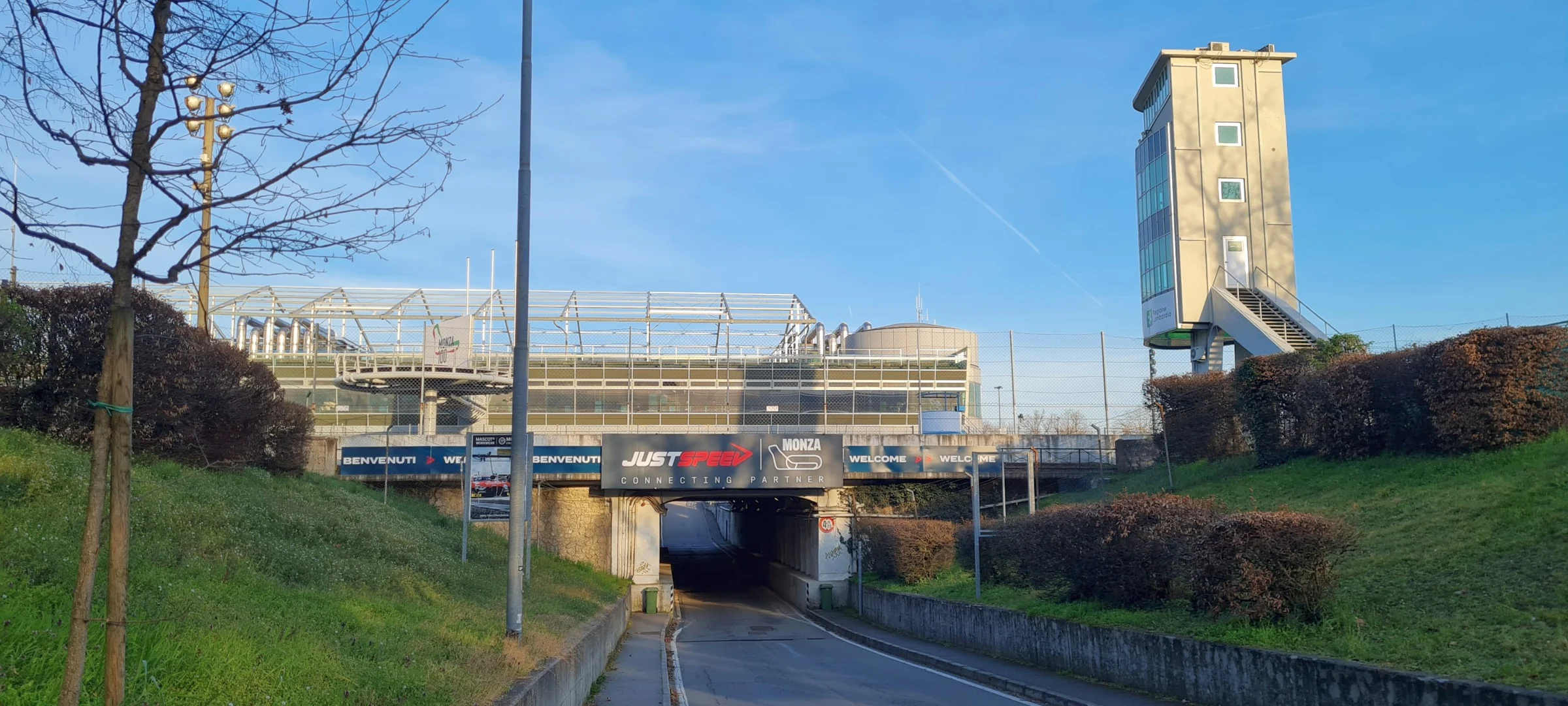
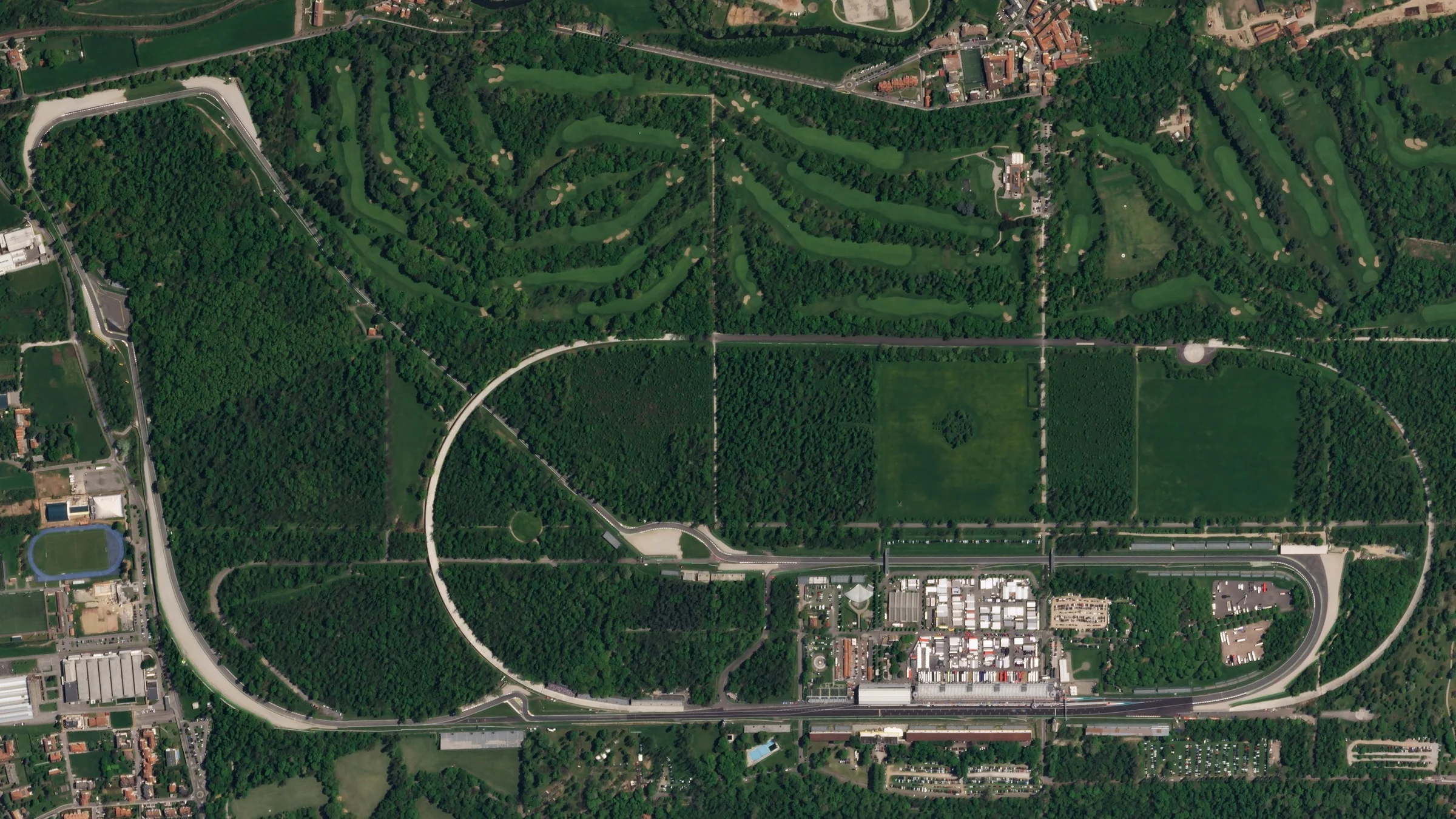
A Monza map looks almost too simple for a circuit with this much history: long straights, two tight chicanes, two right-hand Lesmos, the flowing Ascari sequence and one final curve back to the pits. Yet that simplicity is exactly what makes every detail matter. A small loss at Lesmo 2 carries down the longest acceleration zone; a weak Ascari exit follows the car almost to Curva Alboreto; and a compromised final corner changes the entire run toward Turn 1.
This guide follows the modern 5.793-kilometer, 11-corner Grand Prix circuit in lap order. It explains why several places have two familiar names, separates the official race lap record from the faster qualifying benchmark, and translates the geometry into spectator choices. It also distinguishes a track-outline map from the annual grandstand and access maps—a crucial distinction if you are planning where to sit rather than studying how a lap works.
The result is a circuit guide for fans who want more than labels: what each part asks of an F1 car, why one corner affects the next, and which physical view best matches the action you want to see.
Monza Circuit at a Glance
Lap length
5.793 km
Direction
Clockwise
Turns
11
Race laps
53
The modern Grand Prix layout is 5,793 meters long and runs clockwise, with seven right-hand and four left-hand corners. Monza gives its width as 10 to 12 meters, a useful clue at the chicanes: several cars may arrive together on the opening lap, but the viable racing line narrows abruptly. The main straight itself runs 1,194.40 meters from Curva Alboreto to Prima Variante.
A 53-lap Grand Prix covers a nominal 306.72 kilometers. More important than the arithmetic is how unevenly the work is distributed. Most of the lap is acceleration, full-throttle running and heavy energy demand. The decisive interruptions are few: massive stops for the first and second chicanes, a shorter sequence through the Lesmos, braking and commitment at Ascari, then the long final right-hander. A setup or driving compromise therefore repeats down several straights rather than remaining isolated to one corner.
On a north-up geographic map the lap sits within Monza Park, but television diagrams often rotate the circuit to fit a screen. Use corner sequence, not compass direction, to orient yourself: pits to Prima Variante, Curva Biassono to Roggia, Lesmos to Ascari, then Curva Alboreto back to the main straight. The Italian Grand Prix page adds the weekend sessions and results around that physical lap.
Monza Corner Names, in Lap Order
Monza's official count is 11 corners, but the names do not map neatly to eleven labels. Chicanes combine several numbered turns; Serraglio has a name yet is not counted as an official corner; and Curva Alboreto remains Parabolica in everyday F1 speech. Following the racing direction removes the ambiguity.
Prima Variante to Curva Biassono
Turns 1 and 2, Prima Variante, form the right-left chicane at the end of the main straight. Its literal name—first chicane—is more useful than romantic. The sequence was introduced in 1972 to cut extreme speed and substantially reprofiled in 2000. It creates the lap's starkest speed change and its most obvious first-lap bottleneck. Drivers must combine braking stability with the ability to rotate at very low speed, then avoid losing traction over the exit.
Turn 3, Curva Biassono, is the sweeping right that older fans still call Curva Grande. Formula 1's naming history explains that the early-1970s alterations brought the Biassono identity, borrowed from the nearby town. In a modern F1 car it is normally about confidence and placement rather than a conventional braking event. A poor chicane exit is exposed here because the car is already rebuilding speed toward Roggia.
Roggia, the Lesmos and Serraglio
Turns 4 and 5 are Seconda Variante, commonly Variante della Roggia after a stream in the area. Converted into a chicane in 1976, the left-right sequence is another genuine overtaking and error point. Unlike Turn 1, its approach includes the loaded sweep of Biassono. A driver defending must choose positioning before braking; a driver attacking must still leave a route through the kerbs and protect the exit toward Lesmo 1.
Turns 6 and 7, Lesmo 1 and Lesmo 2, are separate right-handers embedded in the trees. Their shared name comes from the nearby town, though several older descriptions survive. They reward a car that is stable when the driver commits at medium-to-high speed. Lesmo 2 matters disproportionately: its exit begins the long run through the wooded back section, so wheelspin or an unnecessary steering correction costs time long after the corner itself has disappeared in the mirrors.
Serraglio is the very slight left on that run. It recalls a royal hunting lodge and animal enclosure once nearby. It appears on named maps, but Formula 1 does not include it in the official 11-turn count. For lap analysis it is best treated as part of the acceleration zone and the approach to Ascari, where a tow can become strategically important.
Ascari to Curva Alboreto
Turns 8, 9 and 10 make the left-right-left Variante Ascari. The name honors two-time world champion Alberto Ascari, who died in a 1955 testing accident near this part of Monza. This is not a stop-start chicane like Prima Variante. Its broader radii turn entry speed, kerb use and continuous balance into one flowing test. An aggressive first apex can improve rotation yet leave the car badly placed for the final left and the long straight that follows.
Turn 11 is Curva Alboreto, the long right-hander universally familiar as Parabolica. The mathematical-looking arc inspired the older name; the official title now honors former Ferrari driver Michele Alboreto. Both labels describe the same corner. Entry rewards courage, but exit is the real currency because it launches the car along the full main straight. In qualifying the driver can spend tire grip for one decisive arc. In a race, dirty air, defense and the threat of a slipstream attack into Turn 1 change the calculation.
Why Monza Is the Temple of Speed
Monza earns the nickname through repetition. The car accelerates for so long, so often, that aerodynamic drag carries an unusually large lap-time penalty. Teams bring circuit-specific low-downforce bodywork and trim wing load to protect straight-line performance. The reward is speed and overtaking potential; the cost is a car with less aerodynamic support when it must brake, change direction and put power down.
That compromise is visible at Prima Variante. Formula 1 measured 476 meters from pole position to the Turn 1 braking point in its 2026 preview, while the circuit says the entire start straight is 1,194.40 meters. The driver arrives after a prolonged acceleration phase, hits the brakes with relatively little wing, downshifts rapidly and asks the car to accept a sharp right-left transition. If rear stability is weak, braking confidence disappears. If the platform is too stiff or nervous over the kerbs, the shortest geometric path may not be the fastest usable path.
The same trade returns at Roggia and Ascari in different forms. Roggia rewards stopping power and rotation; Ascari demands lateral confidence while retaining enough compliance to ride the sequence without bouncing the car away from the intended line. Traction then controls how quickly the engine and energy system can turn corner exit into speed. This is why a car that tops the speed trap is not automatically the quickest over a lap.
Slipstream changes both qualifying and racing. Following a car can reduce drag and raise speed on a straight, but timing the gap is delicate: too far back and the tow is weak; too close and turbulent air can hurt the next braking or corner phase. Qualifying “traffic” at Monza is often a consequence of everyone wanting space for tire preparation while also seeking a tow. In the race, the draft and overtaking assistance concentrate attacks at the chicanes, yet a pass still depends on braking control and leaving enough tire grip to complete the sequence.
What the Monza Lap Record Actually Means
Two correct Monza “lap records” can appear in search results because they describe different sessions. Formula 1's official race record tracks the fastest lap completed during a Grand Prix. An outright or track best is usually set in qualifying, where the car is configured for a single maximum attack. Always ask which category, layout and date accompany the number.
Race lap record versus qualifying record
| Record | Driver and year | Time | Context |
|---|---|---|---|
| Official race lap | Lando Norris, 2025 | 1:20.901 | Lap 53; 257.781 km/h average |
| Qualifying / outright F1 best | Max Verstappen, 2025 | 1:18.792 | Pole lap; fastest average-speed F1 qualifying lap at the time |
Norris's 1:20.901 came on the final lap of the 2025 Italian Grand Prix, according to Formula 1's official fastest-lap classification. Verstappen's 1:18.792 arrived in Q3 the previous day. Qualifying offers low fuel, fresh soft tires and no requirement to preserve a race stint. A race lap carries fuel-history, tire-life, traffic and strategic context even when it comes late with a lighter car.
Neither number proves one driver or car was universally “faster” than every predecessor. Asphalt, kerbs, circuit layout, tire construction, technical rules, weather and tow all change. A 2004 lap and a 2025 lap are historical data points under different systems. For a current weekend, compare like sessions through the latest F1 results; for history, preserve the category and regulation era beside the stopwatch.
Best Monza Viewing Areas by What You Want to See
There is no single best Monza stand because each part of the map answers a different question. Decide whether you want racecraft under braking, high-speed car behavior, or the ceremony and strategy of the pit straight. Then check the current organizer map for the exact stand number, screen and cover—not an old diagram.
Braking and overtaking: Prima Variante or Roggia
Prima Variante is the natural choice for the start, slipstream attacks and the dramatic transition from maximum speed to a very slow chicane. You can study brake commitment, defensive positioning, lockups and how drivers escape the inside congestion. The trade-off is that Turn 1 incidents can interrupt the race and some seats emphasize the approach more than the exit. The current map should determine whether a specific stand faces braking, apex or acceleration.
Roggia offers a similar overtaking theme with a different approach. Cars arrive after Curva Biassono and must negotiate a left-right sequence before the Lesmos. It is excellent for watching a driver convert a tow into a braking move, then try to retain position through the direction change. Prima Variante usually owns the iconic opening-lap image; Roggia can reveal more about how a pass is constructed after the field spreads.
High-speed car placement: Ascari or Curva Alboreto
Ascari is for fans fascinated by commitment and balance. A useful view spans more than one apex, allowing you to see whether a driver attacks the first left at the expense of the final exit. Differences in kerb use and correction become visible even without telemetry. Because the sequence is quick, photography is harder and race overtakes are less routine than at a stop chicane.
Curva Alboreto—Parabolica—shows a single long corner with enormous consequence. The approach reveals late-braking confidence; the middle exposes patience; the exit determines speed past pits and toward Turn 1. It can be a strong compromise for spectators who want both cornering and the sensation of sustained acceleration. Exact views vary widely among the several inside, outside and lateral stands carrying Parabolica-related labels.
Grid, pits and podium: the main straight
Centrale and the finish-line areas concentrate the human theater: formation, grid procedure, pit stops, checkered flag and podium. You see teams working and can follow strategic timing more directly, especially with a screen. What you may not see is a car loaded through a complex sequence; on the straight, the astonishing speed can make each pass fleeting.
For ticket decisions, combine this performance guide with our Monza 2027 ticket and general-admission guide. It explains how reservation, arrival time and seller choice alter the experience. A corner can be perfect on the circuit map yet wrong for a group that needs shelter, accessible routing or a guaranteed seat.
Which Monza Map Should You Use?
Use the map that matches the task. A clean circuit outline is ideal for learning corner order and understanding a lap. A grandstand map is needed to compare ticket sectors. A race-weekend access map is needed for gates, fan zones, toilets, water points, shuttles and closures. A normal street map helps reach Monza Park but cannot show temporary crowd controls inside a major event.
- Studying the race: choose a current 11-turn Grand Prix outline with direction arrows and corner names.
- Buying a seat: use the organizer's current-year grandstand diagram and match the exact number/letter to the listing.
- Planning race day: download the latest event map after gates and services are published.
- Navigating the region: use live rail, road and walking directions, then switch to the organizer map at the park.
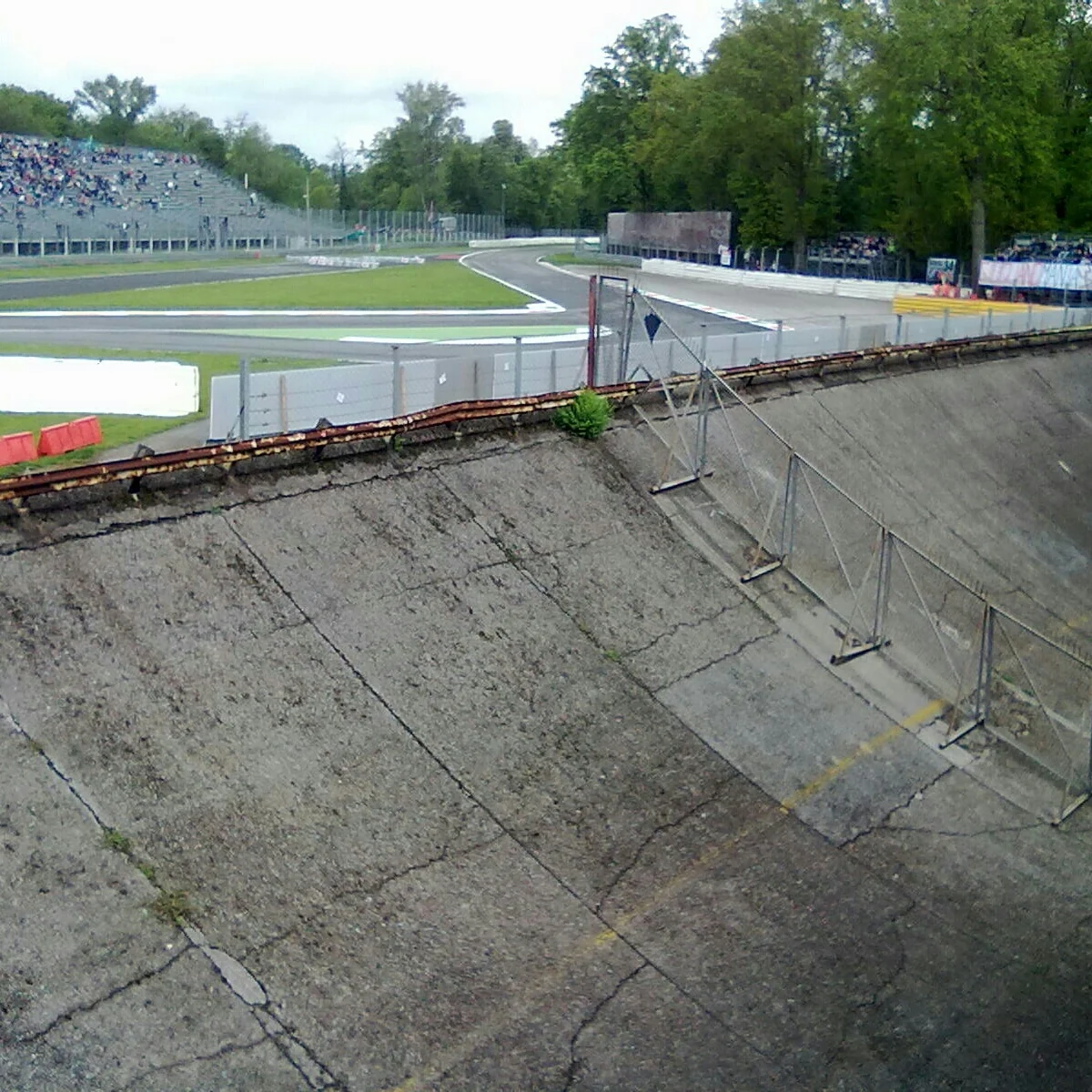
Historic diagrams often emphasize Monza's banked oval, an extraordinary surviving landmark that intersects the visual identity of the venue. It is not the modern F1 racing line. Satellite imagery can also make paths look open when race-weekend fencing blocks them. Likewise, a PDF from a previous Grand Prix can have familiar stand numbers yet outdated entrances or public zones.
Save the current event map offline and mark your gate, sector and one backup meeting point. Then keep the lap map for what it does best: translating a burst of engine note in the trees into a position and a consequence. With the sequence learned, the Italian Grand Prix page becomes easier to read because every session time and result belongs to a physical challenge you can picture.
Loading comments…