
Kimi Antonelli will win the 2026 Formula 1 Drivers’ Championship in Mexico if he finishes ninth or higher. That is the uncomplicated answer before the November 1 race. Tenth can also be enough, and even a scoreless Sunday can deliver the title, depending on who wins. The important distinction is between the result that guarantees the crown and the weaker results that need help elsewhere.
This guide uses the championship position on October 30, before Mexico practice: Antonelli has 365 points, George Russell 242 and Lewis Hamilton 241. His Austin victory left only those two rivals mathematically alive. A comfortable advantage is still different from a completed championship, and the final classification rather than a television graphic settles the calculation.
Below are the exact finishing branches, the reason a 100-point lead can be decisive, and the separate Mercedes constructors’ equation. Keep the current F1 standings alongside the race: every example assumes the scheduled remaining calendar and the applicable points award, rather than a prediction of how Mexico will unfold.
The numbers behind Antonelli's Mexico title chance
Start with the rivals’ ceilings, rather than with how unlikely a comeback feels. Russell trails by 123 points and Hamilton by 124. There are 125 available to one driver over the five scheduled Grands Prix still to run. Therefore Russell can theoretically reach 367 and Hamilton 366 if either wins every remaining race. Antonelli already has 365. Those totals show why two additional points are sufficient across the rest of the campaign, even before examining a particular finishing order.
They also explain why Max Verstappen, despite remaining a potential race winner, cannot win this championship on the current numbers. His 236 points plus a perfect 125 gives 361, four short of Antonelli's existing score. Charles Leclerc starts still further back on 233. Their Mexico performances can affect who wins and consequently whether the title is confirmed, but they no longer have an independent mathematical path to the drivers’ trophy.
Why 100 points remain after Mexico
The current calendar leaves São Paulo, Las Vegas, Qatar and Abu Dhabi after Mexico. With 25 points available for each Grand Prix victory and no remaining Sprint, that is four multiplied by 25: 100 points. Do not add an old fastest-lap bonus or assume a Sprint accompanies the next Brazilian weekend. The scoring format and the actual calendar have to be read together; counting race weekends alone can produce a plausible-looking but incorrect maximum.
The useful race-day question is therefore whether either rival can leave Mexico less than 100 points behind. An exact 100-point deficit is already too large because Antonelli owns an unbeatable race-win countback. This is why simply demanding a lead greater than the remaining points would set an unnecessarily strict target. Our F1 points-system guide covers the wider scoring framework; here, the distinction directly changes which Mexico finishing positions clinch the title.
These are ceilings under the calendar currently published, not claims that every remaining event is guaranteed to happen. Recalculate if the official schedule changes. A rumored replacement or cancellation should never quietly enter a live championship calculation.
Every full-points finishing scenario
For a normal full-points Mexico race, the meaningful branches fit into six rows. "Any result" means any result consistent with the other listed positions; Russell and Hamilton cannot both occupy first place in an ordinary classified finish. The table is a championship calculator, not a prediction of the finishing order.
| Antonelli | Russell | Hamilton | Drivers’ title |
|---|---|---|---|
| Ninth or higher | Any result | Any result | Antonelli clinches |
| Tenth | Winner | Any result | Continues to São Paulo |
| Tenth | Second or lower | Any result | Antonelli clinches |
| No points | Winner | Any result | Continues |
| No points | Second or lower | Winner | Continues |
| No points | Second or lower | Second or lower | Antonelli clinches |
Ninth or better settles the championship
Ninth gives Antonelli two points and lifts him to 367. If Russell wins, he reaches 267, exactly 100 behind. Even four more victories would only draw him level. If Hamilton wins instead, he reaches 266 and remains 101 behind. Neither path overturns the leader. Every position above ninth improves Antonelli's score, so no separate podium or victory condition needs to be added.
This is a useful example of how a championship target can be far below a driver's normal race target. Antonelli can race for a strong result while the mathematical safety threshold sits in the lower points. Ninth does not mean that deliberately dropping to ninth is sensible strategy. Traffic, pit-stop timing and the risk of losing another position still make a cleaner, faster race valuable.
Tenth leaves only Russell with a route
Tenth takes Antonelli to 366. A Russell victory produces 267, leaving a 99-point gap and a one-point theoretical opening over the final four races. Hamilton winning produces 266 instead: precisely 100 behind, which countback closes. Therefore "Antonelli must finish ninth" is a guarantee statement, not a statement that tenth cannot secure the championship.
If Russell is second while Antonelli is tenth, the Mercedes totals become 260 and 366, a 106-point gap. Hamilton's possible victory still cannot rescue the title fight. That combination is worth remembering when the cameras follow the winner: the champion might be running at the bottom of the points while another driver celebrates the race victory. Check the final race result before treating a late position change as definitive, because a time penalty can move a car across the ninth-tenth or tenth-eleventh boundary.
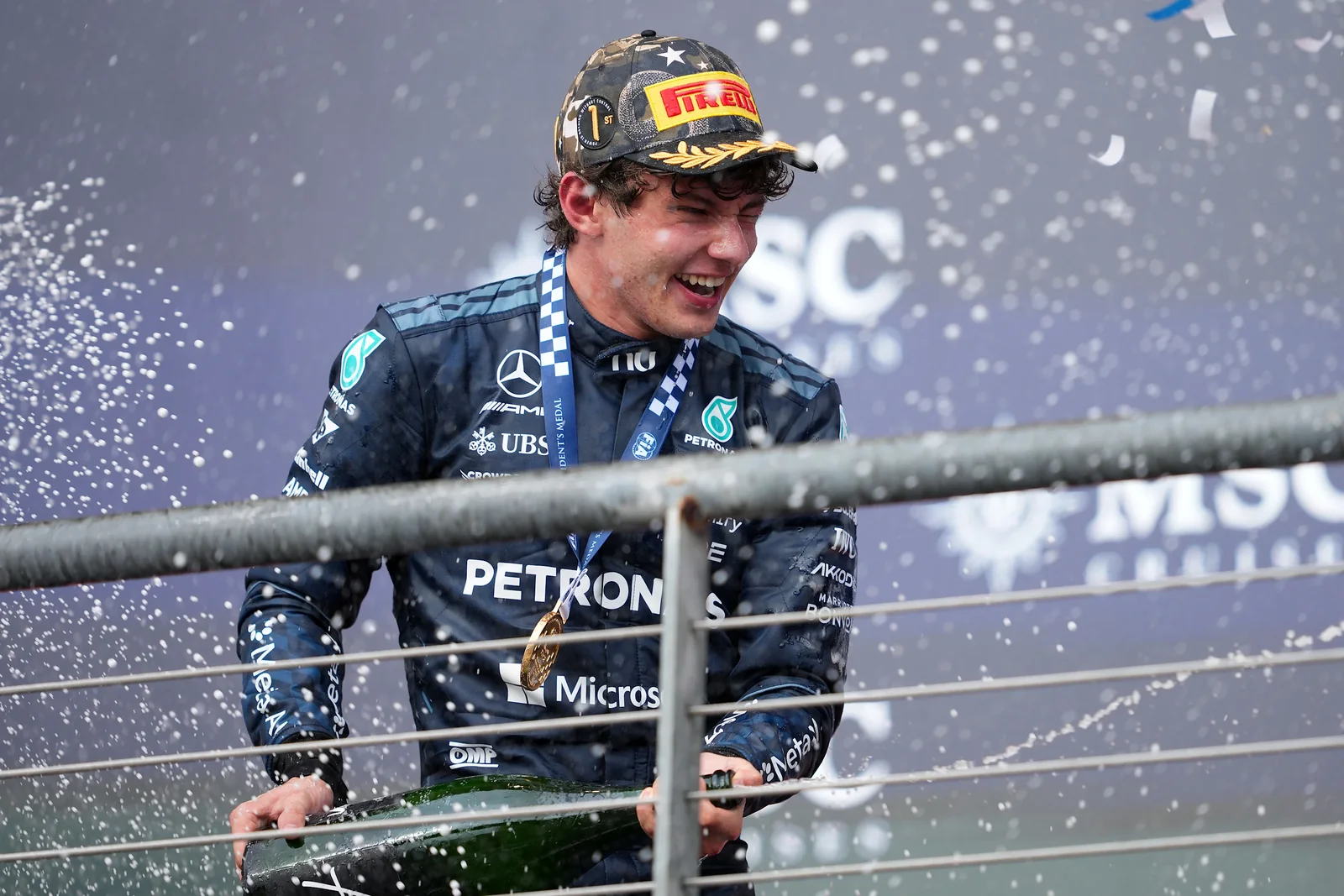
Can Antonelli become champion without scoring?
Yes. If Antonelli stays on 365 and somebody other than Russell or Hamilton wins Mexico, neither remaining challenger can take enough points to preserve the fight. Russell's best possible second place would put him on 260, 105 behind. Hamilton's best possible second would put him on 259, 106 behind. Both gaps exceed the 100 points available afterward. A victory for an already eliminated contender could therefore decide the championship in Antonelli's favor.
The exceptions are equally precise. A Russell win against zero points for Antonelli reduces the gap to 98. A Hamilton win reduces it to 99. Each winner would still need an extraordinary run afterward, but extraordinary is not the same as impossible. Mathematical elimination waits until the rival's maximum cannot beat the leader's score and applicable tiebreak.
Calculate this using points actually awarded. A retirement label is not always synonymous with zero points: a car that stops late can still appear in the classified result, depending on completed distance and the final order. Conversely, reaching the chequered flag outside the scoring places adds nothing. For the championship equation, the final points column matters more than the shorthand description of the afternoon.
Missing media day is not a withdrawal
Antonelli's October 29 absence added a separate question. RACER reported a Mercedes statement saying he was recovering from a viral illness and had been excused by the FIA from media duties, with the team expecting him back on Friday. That was a contemporaneous expectation, not confirmation of either a race withdrawal or completed recovery. The report still listed him to drive FP1, while Fred Vesti was due to replace Russell.
Even a genuine non-start would leave the same zero-point arithmetic, provided no other championship adjustment intervened. It would not automatically make Antonelli champion or automatically postpone the decision. Watch the rivals’ winning chances and confirmed participation updates separately. The weekend schedule helps locate the next session; a medical-day headline cannot substitute for an official starting status.
Why a tie on points would still favor Antonelli
The tie rule compares race wins first, then second places, then third places and so on. Antonelli already has nine Grand Prix victories. Russell has three, so even winning all five races still scheduled would bring him only to eight. Hamilton has one, leaving a maximum of six. Antonelli therefore does not need to win another race to protect this particular tiebreak. The comparison is already beyond either rival's reach.
Put the most easily misunderstood scenario through to the end. Antonelli finishes ninth in Mexico and reaches 367; Russell wins and reaches 267. Imagine Russell then wins São Paulo, Las Vegas, Qatar and Abu Dhabi while Antonelli adds nothing. The final points would be 367 apiece. Russell would have eight race wins, Antonelli nine, and Antonelli would be champion. Mexico has therefore made the title mathematically secure even though an equal final points total remains possible.
This does not award Antonelli imaginary future points. His advantage comes from results already achieved. Nor is it the same as sharing points for cars tied in a particular race result: an event dead heat and equal season totals are different regulatory problems. Keeping those mechanisms separate avoids the mistaken argument that the championship would have to wait until Abu Dhabi simply because a numerical tie can still be constructed.
The sequence also explains why Russell and Hamilton are not interchangeable in the tenth-place scenario. A Hamilton win followed by four more victories can produce a tie with Antonelli on 366, but Hamilton loses the first tiebreak. Russell starts one point higher and can instead reach 367, so his route against a tenth-place Antonelli survives. That single starting point creates the different answer; it has nothing to do with which team the rival represents.
Our earlier 2026 championship forecast considered the competitive outlook at an earlier snapshot. This Mexico calculation answers a narrower question: whether any legal combination of remaining results can change the title winner. Race pace and title probability matter to a forecast, whereas a clinching calculation must work even under the most unfavorable remaining results for the leader.
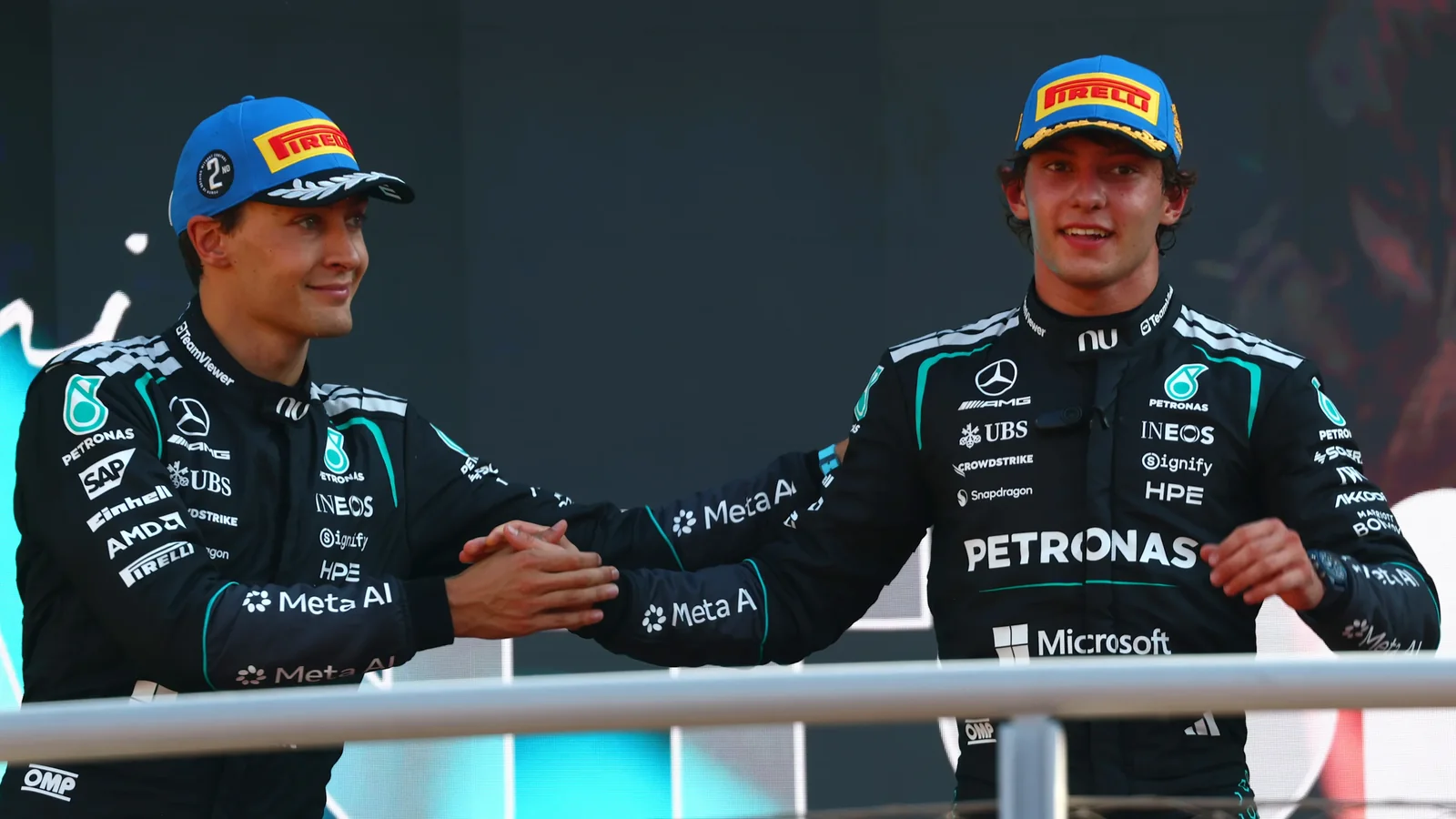
Mercedes has a different championship calculation
Mercedes arrives on 607 constructors’ points, Ferrari on 474: a 133-point lead. A constructor can score 43 from a standard Grand Prix by finishing first and second, so the four rounds after Mexico offer a maximum of 172. Mercedes needs to increase its advantage by 39 points to reach that decisive boundary. The team's existing race-win advantage also protects an equal final points total.
The difference from Antonelli's calculation is structural. One driver can collect only the points from one finishing position, but a team adds both cars. Ferrari still has two opportunities to take points away from Mercedes every Sunday. A Mercedes driver securing his individual crown with a ninth-place finish would say very little about whether the combined team score has reached the constructors’ target.
Two realistic scoring combinations to watch
A Mercedes one-two supplies 43. Ferrari must score four points or fewer, because 43 minus four adds the required 39 to the gap. A Mercedes first and third supplies 40, so Ferrari must score one point or fewer. These are valid scoring combinations, not assessments of how likely Ferrari is to suffer a poor afternoon. A Mercedes second and third supplies only 33 and cannot achieve the necessary gain even if neither Ferrari scores.
For a concrete example, a Mercedes one-two and a single Ferrari eighth place would give 43 against four. The championship gap becomes 172, matching the four-race maximum Ferrari could still collect. If that Ferrari finishes seventh instead, its six points leave a gain of 37 and a gap of 170. Two positions in the lower points therefore distinguish a mathematical clinch from another week of waiting.
This is also why an instruction to preserve the individual drivers’ outcome cannot be assumed to explain every strategic choice. Mercedes might still value a second strong finish for the team championship, while Ferrari has an incentive to recover even a handful of points. Those are sporting incentives visible from the table, not evidence of a particular undisclosed team order. Follow both cars and the constructors’ standings before interpreting a late pit call as purely an Antonelli title decision.
What to watch before calling the title decided
The first sporting watchpoint is where Antonelli runs relative to the lower points, especially after his final planned stop. A temporary tenth during a pit cycle is different from a likely tenth at the finish. Look at tire age, remaining stops and gaps to cars that may still receive a penalty. With only one position separating a guarantee from a conditional result, a live championship graphic can change without the underlying race becoming dramatically worse.
The second is the identity of the likely winner. If Antonelli is outside the points, a Russell or Hamilton lead preserves the mathematical possibility; a different winner removes it. If Antonelli is tenth, only Russell winning matters. This lets viewers follow the right battle instead of repeatedly checking every contender's theoretical maximum after each lap. The Mexico weekend timetable identifies the sessions that establish the actual starting picture.
Mexico still requires ordinary race execution. Williams’ technical preview identifies cooling in thin air and the newly resurfaced track as important constraints. A championship margin does not eliminate those physical demands. Conserving a car can be sensible, but falling into traffic can create its own thermal and overtaking problems. There is no basis before practice to prescribe a Mercedes stint length or declare that one particular pit strategy is the safe title option.
Reduced points make the full-points table conditional. If the winning score is 19 rather than 25, even a scoreless Antonelli remains at least 104 points ahead of Russell and 105 ahead of Hamilton. Either margin already exceeds the 100 remaining. Smaller awards cannot preserve their routes either. If Mexico awards no points and is not subsequently added back, the existing gaps also suffice against the same four-race remainder. Use the FIA's actual points award; do not infer it merely from a red flag or a race ending against the time limit.
Finally, separate a likely television moment from the confirmed classification. Post-race penalties or a changed official calendar can require recalculation. Under the currently scheduled full-points scenario, the practical decision tree remains compact: ninth guarantees the crown, tenth requires Russell not to win, and zero points requires neither Russell nor Hamilton to win. That is the calculation to carry into Sunday, alongside the final sporting decisions.
Loading comments…