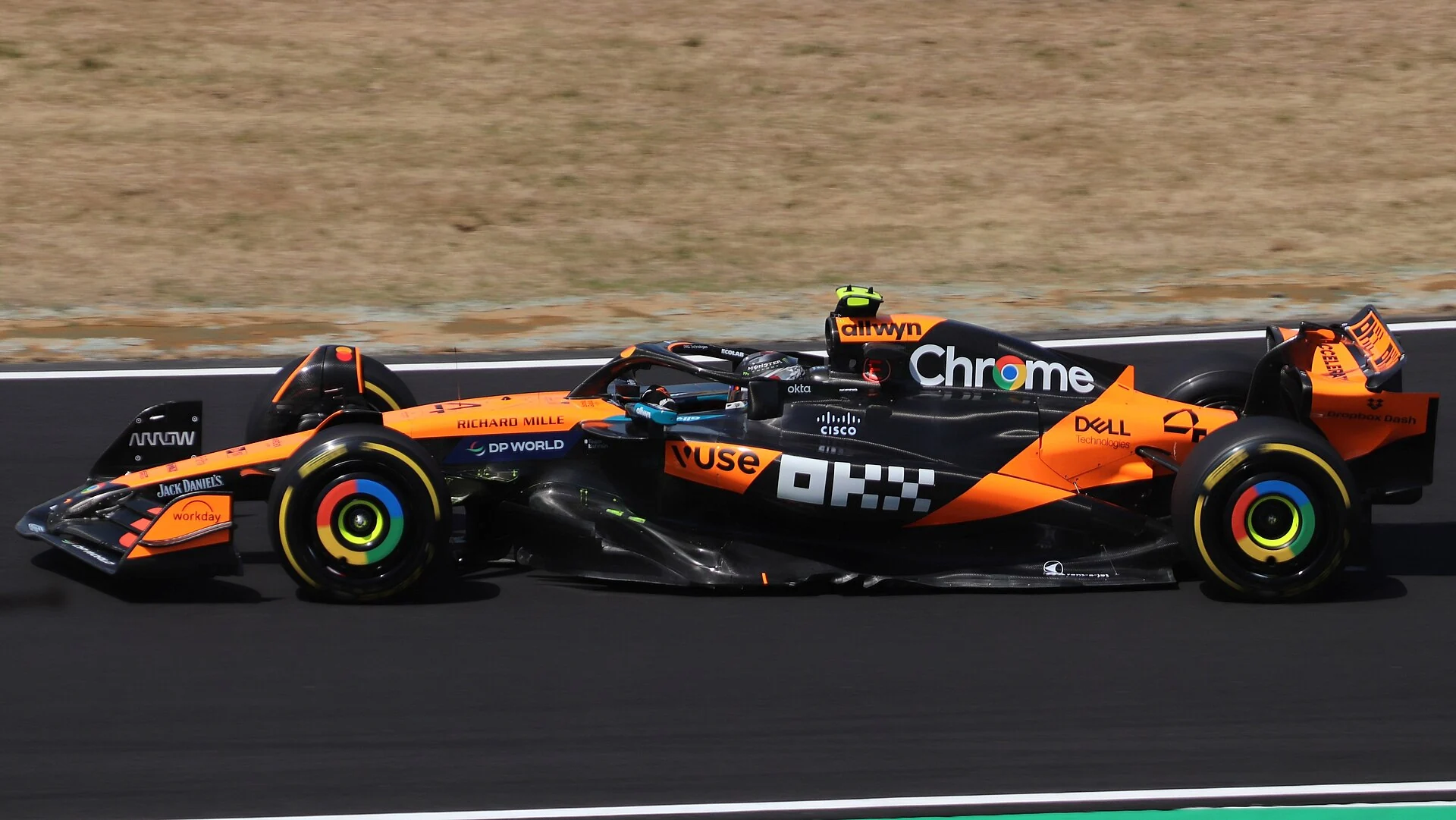
The 2025 Formula 1 season ended with two very different championship margins. Lando Norris beat Max Verstappen by just two points for the Drivers' title, while McLaren finished 364 points clear of its nearest rival in the Constructors' table. The same 24 Grands Prix produced a close individual finish and a commanding team result.
This guide keeps the final 2025 record in one place: every classified driver and team, every Grand Prix winner, and an explanation of how the top three drivers reached the Abu Dhabi finale. The results are taken from Formula 1's completed-season archives. For the ongoing championship, use our live F1 standings; these 2025 totals will not change with a 2026 race.
Final 2025 F1 Drivers' Championship standings
Norris ended 2025 on 423 points, Verstappen on 421 and Oscar Piastri on 410. A two-point title gap after 24 Grands Prix is the headline, but third place matters too: three drivers remained close enough that a different late-season finish could have changed the champion. The official year-end table contains 21 classified drivers because Alpine used both Jack Doohan and Franco Colapinto during the season. Excluding a zero-point replacement driver would make the archive incomplete.
| Pos. | Driver | Team in final table | Pts. |
|---|---|---|---|
| 1 | Lando Norris | McLaren | 423 |
| 2 | Max Verstappen | Red Bull Racing | 421 |
| 3 | Oscar Piastri | McLaren | 410 |
| 4 | George Russell | Mercedes | 319 |
| 5 | Charles Leclerc | Ferrari | 242 |
| 6 | Lewis Hamilton | Ferrari | 156 |
| 7 | Kimi Antonelli | Mercedes | 150 |
| 8 | Alexander Albon | Williams | 73 |
| 9 | Carlos Sainz | Williams | 64 |
| 10 | Fernando Alonso | Aston Martin | 56 |
| 11 | Nico Hülkenberg | Kick Sauber | 51 |
| 12 | Isack Hadjar | Racing Bulls | 51 |
| 13 | Oliver Bearman | Haas F1 Team | 41 |
| 14 | Liam Lawson | Racing Bulls | 38 |
| 15 | Esteban Ocon | Haas F1 Team | 38 |
| 16 | Lance Stroll | Aston Martin | 33 |
| 17 | Yuki Tsunoda | Red Bull Racing | 33 |
| 18 | Pierre Gasly | Alpine | 22 |
| 19 | Gabriel Bortoleto | Kick Sauber | 19 |
| 20 | Franco Colapinto | Alpine | 0 |
| 21 | Jack Doohan | Alpine | 0 |
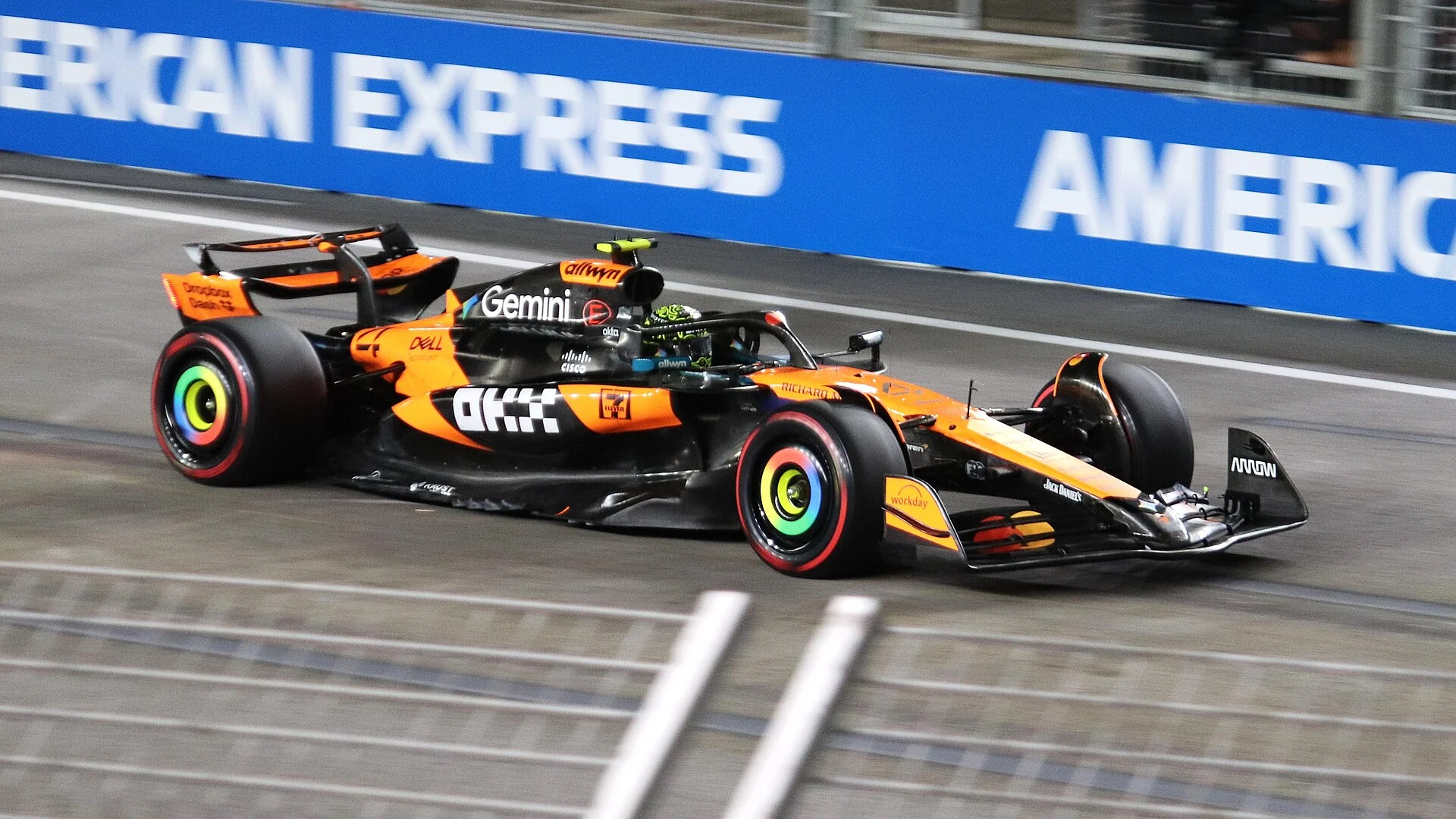
The ranking is the official classification, not a sort performed on points alone. Hülkenberg and Hadjar both scored 51, yet occupy 11th and 12th; Lawson and Ocon share 38 in 14th and 15th; Stroll and Tsunoda share 33 in 16th and 17th. A reader building a spreadsheet should preserve F1's ordering rather than treating every points tie as an equal finishing position. Doohan's zero-point entry remains classified 21st.
Norris's path to 423 was not uninterrupted. Formula 1's race-by-race record includes retirements in Canada and the Netherlands and a Las Vegas disqualification, yet his repeated high finishes and seven Grand Prix victories still delivered the title. Verstappen won more races, while Piastri matched Norris's seven. That mismatch between wins and final points is why the championship is an accumulation contest. It rewards the full season, including weekends when a contender finishes second or third rather than first.
Russell's 319 points placed him a distant fourth behind the leading three but well ahead of fifth-place Charles Leclerc on 242. Further down, Williams had two drivers in the top nine, a useful clue to its fifth-place team finish. Driver placements give that context, but they cannot be added blindly to recreate every constructor's number: midseason team changes and Sprint or race classifications must be attributed to the entry that actually earned them.
Final 2025 F1 Constructors' Championship standings
McLaren's 833 points were more than a trophy-winning total: they put the team 364 points ahead of Mercedes at the end of the season. Formula 1's team history says McLaren secured the crown with six rounds still to run, which fits the final table's broad gap. The second-place fight was much tighter. Mercedes finished on 469, only 18 clear of Red Bull Racing's 451, while Ferrari ended fourth with 398. A season can therefore have a decisive champion and significant races for position immediately behind it.
| Pos. | Constructor | Pts. |
|---|---|---|
| 1 | McLaren | 833 |
| 2 | Mercedes | 469 |
| 3 | Red Bull Racing | 451 |
| 4 | Ferrari | 398 |
| 5 | Williams | 137 |
| 6 | Racing Bulls | 92 |
| 7 | Aston Martin | 89 |
| 8 | Haas F1 Team | 79 |
| 9 | Kick Sauber | 70 |
| 10 | Alpine | 22 |
The McLaren pairing explains why the Drivers' title fight could be fierce even while the team title was settled early. Norris scored 423 and Piastri 410, each contributing heavily to the same constructor total. Mercedes' 469 came with Russell fourth in the driver table and Antonelli seventh; Ferrari's 398 came with Leclerc fifth and Hamilton sixth. Those relationships help describe the breadth of each team's scoring without claiming that one single weekend or technical feature decided a 24-race championship.
Red Bull provides the counterexample to McLaren's two-driver balance. Verstappen's 421 was almost the entire team's 451-point total, yet he came within two points of the individual crown. That is not a criticism of the drivers who occupied the other Red Bull seat; midseason moves, opportunity, car behavior and execution need race-by-race analysis. It does, however, show why the team and driver titles can have very different margins. A single contender can sustain a personal challenge while its constructor trails a deeper rival lineup.
The midfield also rewards attention. Williams' fifth place on 137 points was 45 ahead of Racing Bulls, while Racing Bulls was only three ahead of Aston Martin. Haas and Kick Sauber followed within nine points of each other. Those close team positions can affect a season's practical stakes long after the championship leader becomes unreachable. The final table captures who converted enough Sunday and Sprint opportunities to take each place; it should be read as the official order, not as a simple ranking of average qualifying speed.
Every 2025 Grand Prix winner, round by round
Four drivers won the 24 championship Grands Prix in 2025. Verstappen led the count with eight victories; Norris and Piastri each took seven; Russell won twice. The list below follows Formula 1's official race-results archive in calendar order. It records Grand Prix race winners only, so a Sprint victory is not silently added as an extra race win. A Sprint can affect championship points without changing the winner of that weekend's main Grand Prix.
| Rd. | Race date | Grand Prix | Winner | Team |
|---|---|---|---|---|
| 1 | Mar 16 | Australia | Lando Norris | McLaren |
| 2 | Mar 23 | China | Oscar Piastri | McLaren |
| 3 | Apr 6 | Japan | Max Verstappen | Red Bull Racing |
| 4 | Apr 13 | Bahrain | Oscar Piastri | McLaren |
| 5 | Apr 20 | Saudi Arabia | Oscar Piastri | McLaren |
| 6 | May 4 | Miami | Oscar Piastri | McLaren |
| 7 | May 18 | Emilia-Romagna | Max Verstappen | Red Bull Racing |
| 8 | May 25 | Monaco | Lando Norris | McLaren |
| 9 | Jun 1 | Spain | Oscar Piastri | McLaren |
| 10 | Jun 15 | Canada | George Russell | Mercedes |
| 11 | Jun 29 | Austria | Lando Norris | McLaren |
| 12 | Jul 6 | Great Britain | Lando Norris | McLaren |
| 13 | Jul 27 | Belgium | Oscar Piastri | McLaren |
| 14 | Aug 3 | Hungary | Lando Norris | McLaren |
| 15 | Aug 31 | Netherlands | Oscar Piastri | McLaren |
| 16 | Sep 7 | Italy | Max Verstappen | Red Bull Racing |
| 17 | Sep 21 | Azerbaijan | Max Verstappen | Red Bull Racing |
| 18 | Oct 5 | Singapore | George Russell | Mercedes |
| 19 | Oct 19 | United States | Max Verstappen | Red Bull Racing |
| 20 | Oct 26 | Mexico | Lando Norris | McLaren |
| 21 | Nov 9 | Brazil | Lando Norris | McLaren |
| 22 | Nov 22 | Las Vegas | Max Verstappen | Red Bull Racing |
| 23 | Nov 30 | Qatar | Max Verstappen | Red Bull Racing |
| 24 | Dec 7 | Abu Dhabi | Max Verstappen | Red Bull Racing |
McLaren won 14 of those races, split evenly between Norris and Piastri. That was more than half the calendar and helps explain how the team reached 833 constructor points. The table also shows why the individual title was not automatically decided by the team’s lead. McLaren's victories were divided between two candidates, while Verstappen won eight races for Red Bull and remained in contention all the way to the finale. Which driver took points on non-winning weekends mattered as much as the raw win count.
The sequence changed during the year. Piastri took four wins between China and Miami and led McLaren's early victory run; Norris answered with Monaco, Austria and Great Britain, then won in Hungary. Piastri's Dutch Grand Prix win was his seventh and last of the year. Verstappen's run grew stronger in the closing stages, with victories in Italy, Azerbaijan, the United States, Las Vegas, Qatar and Abu Dhabi. Russell's wins in Canada and Singapore interrupted the McLaren–Red Bull pattern and show that the season was not a strict two-team sweep at every venue.
The last three rows make a crucial distinction. Verstappen won the final three listed Grands Prix, yet Norris still became world champion. Abu Dhabi's winner did not take the title simply by crossing first; the accumulated scores across all 24 rounds decided it. To understand that two-point finish, the winner list has to be read beside the complete driver classification, including podiums, Sprint points, retirements and disqualifications.
How Norris survived the three-driver title fight
The final standings can make 2025 look like a duel decided at the last corner of the last race. It was a longer three-driver contest. Piastri controlled much of the middle of the season, Norris recovered to lead late, and Verstappen transformed a large deficit into a last-round challenge. Each swing depended on full-race classifications and points, not merely who appeared quickest on one Saturday. Looking at the points after the Dutch, Mexican and Las Vegas Grands Prix clarifies how all three reached Abu Dhabi with a possible route to the title.
Piastri's midseason lead and Norris's recovery
Piastri's early sequence of wins gave him the championship lead after Round 5. He remained strong into the summer, winning Belgium and then the Netherlands. The Dutch Grand Prix was the starkest single change between the McLaren teammates: Piastri won while Norris retired. After Round 15, Piastri was 34 points ahead of Norris and 104 ahead of Verstappen, according to Formula 1's season timeline. That was a genuine lead, not a temporary live-timing artifact, and it explains why Piastri looked like the favorite at that point.
The later order reversed. Norris kept collecting strong results and won in Mexico and Brazil; Formula 1 records that he regained the Drivers' Championship lead at Mexico, Round 20. Piastri did not win another Grand Prix after the Netherlands, but it would be careless to assert a single unseen car or psychological cause from that fact alone. Each remaining weekend had its own track conditions, race incidents, qualifying positions and strategy decisions. The hard championship result is that Norris turned a 34-point Dutch deficit into a final 13-point advantage over his teammate.
Verstappen's late charge and the Abu Dhabi decider
Verstappen's comeback was extraordinary in scale. He had trailed Piastri by 104 points after the Dutch Grand Prix, yet wins in Italy, Azerbaijan, the United States and then the final three Grands Prix made him Norris's nearest challenger by the finale. The late run was helped by his own results and by points that the McLarens failed to collect. The most conspicuous setback for both McLaren drivers came in Las Vegas: Norris crossed the line second and Piastri fourth, but both were disqualified after checks found rear skid wear below the required 9mm minimum. The final classification therefore awarded neither driver points there.
Following the Las Vegas decision, Norris led with 390 points, while Verstappen and Piastri were level on 366 with two rounds left. That made the Qatar and Abu Dhabi weekends more than formalities despite McLaren's already-secured team title. Verstappen won both Grands Prix, but the decisive Abu Dhabi arithmetic still favored Norris if he finished on the podium. He qualified between Verstappen and Piastri, lost second to his teammate on the opening lap, and held third through the race. The official finishing order was Verstappen, Piastri, Norris. Those 15 points for third took Norris to 423, two ahead of Verstappen's 421.
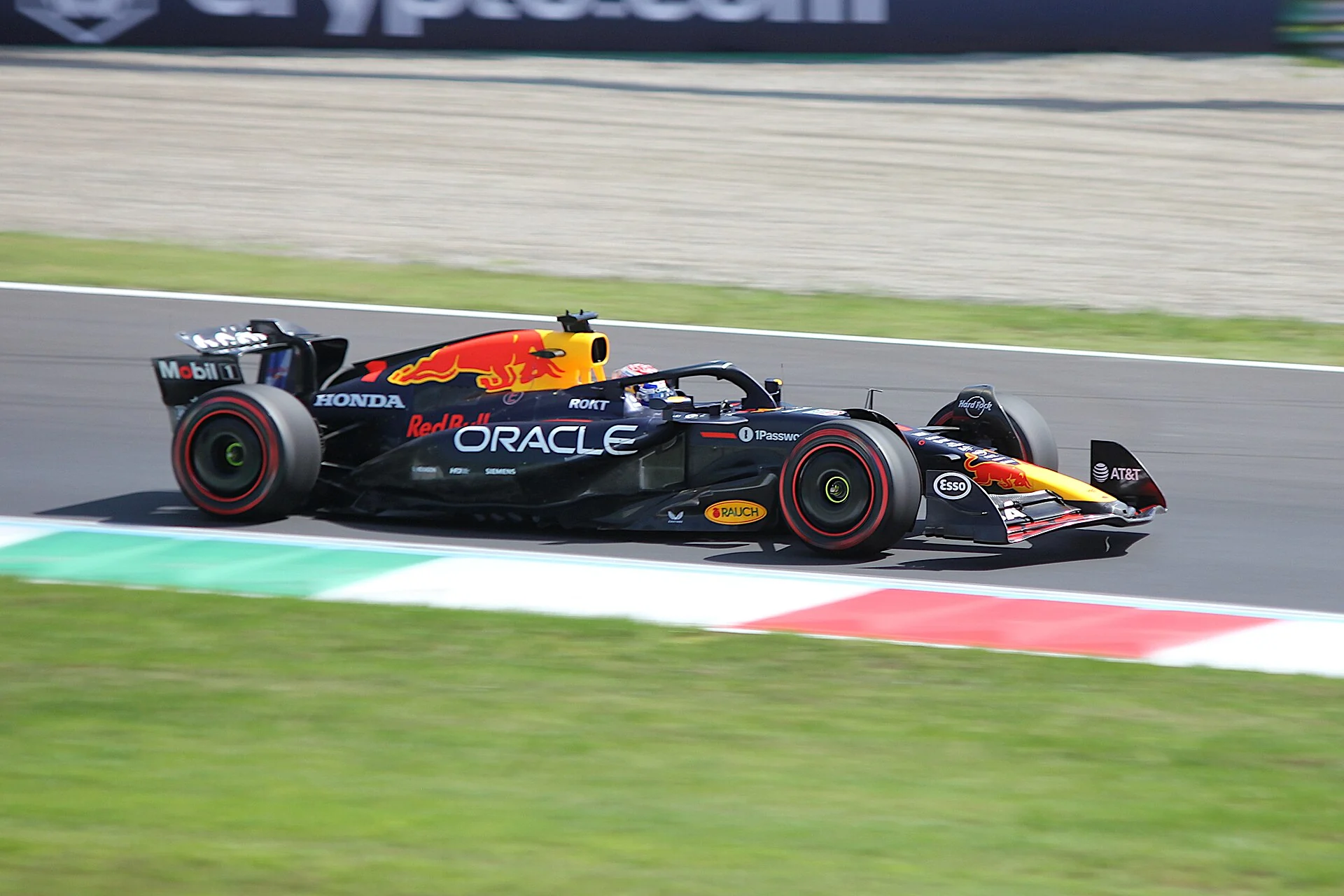
Las Vegas was a major championship swing, yet it does not account for every point in a 24-race season. Norris had to recover from earlier retirements; Piastri built and then lost a substantial lead; Verstappen needed repeated late wins to make the title fight close. The final Abu Dhabi podium settled the award under the actual rules and classifications. It did not erase the very different routes all three contenders took to reach it.
What the final tables reveal beyond the champion
The 2025 record is richer than a one-line note that Norris and McLaren were champions. McLaren's own year-end account credited Norris and Piastri with 14 Grand Prix wins and 34 podiums between them. Both drivers were still in the title contest at the final round, yet their combined results had made the team championship secure much earlier. That is an unusually clear example of the two trophies rewarding different patterns: the drivers split the leading team's high scores between themselves, while the constructor collected them together.
Verstappen's eight wins illustrate the other side. He had more Grand Prix victories than either McLaren driver and finished just two points short of Norris, but Red Bull ranked third among teams. Winning a race is worth the maximum Grand Prix haul for one car; winning the Constructors' Championship asks an operation to produce strong combined scoring over the calendar. The driver title challenge and the team rank are therefore both true, even though they look contradictory in a quick headline comparison.
The classification also preserves a meaningful midfield result. Williams finished fifth with 137 points, and Formula 1's end-of-year review highlights Carlos Sainz podiums in Azerbaijan and Qatar. His 64 driver points and Alexander Albon's 73 gave the team two substantive contributors. Lower down, Racing Bulls finished only three points ahead of Aston Martin. A single weekend at that margin could have changed their final places, which is why official points and classifications matter beyond the top four.
There is an accounting trap in the driver table. Liam Lawson started 2025 at Red Bull, and Yuki Tsunoda started at Racing Bulls; the teams swapped them from the Japanese Grand Prix. Formula 1's final driver table displays one team beside each driver's season total, but those season totals cannot all be assigned to that displayed team. Points earned before the switch belonged to the entry for which the driver raced at that event. Use the official constructor table for the team totals rather than adding every driver row whose final label looks like a match.
Finally, keep the archive and the active season in separate tabs mentally. These 2025 results are settled: Norris 423, Verstappen 421, McLaren 833, and 24 recorded Grand Prix winners. The current F1 standings are the right tool for following 2026's shifting order. Comparing a live gap with 2025's final two-point driver margin can be illuminating, but a live season can still change with every race classification. The lasting 2025 lesson is to read the whole championship: wins, consistent finishes, teammates and official penalties together.
Loading comments…