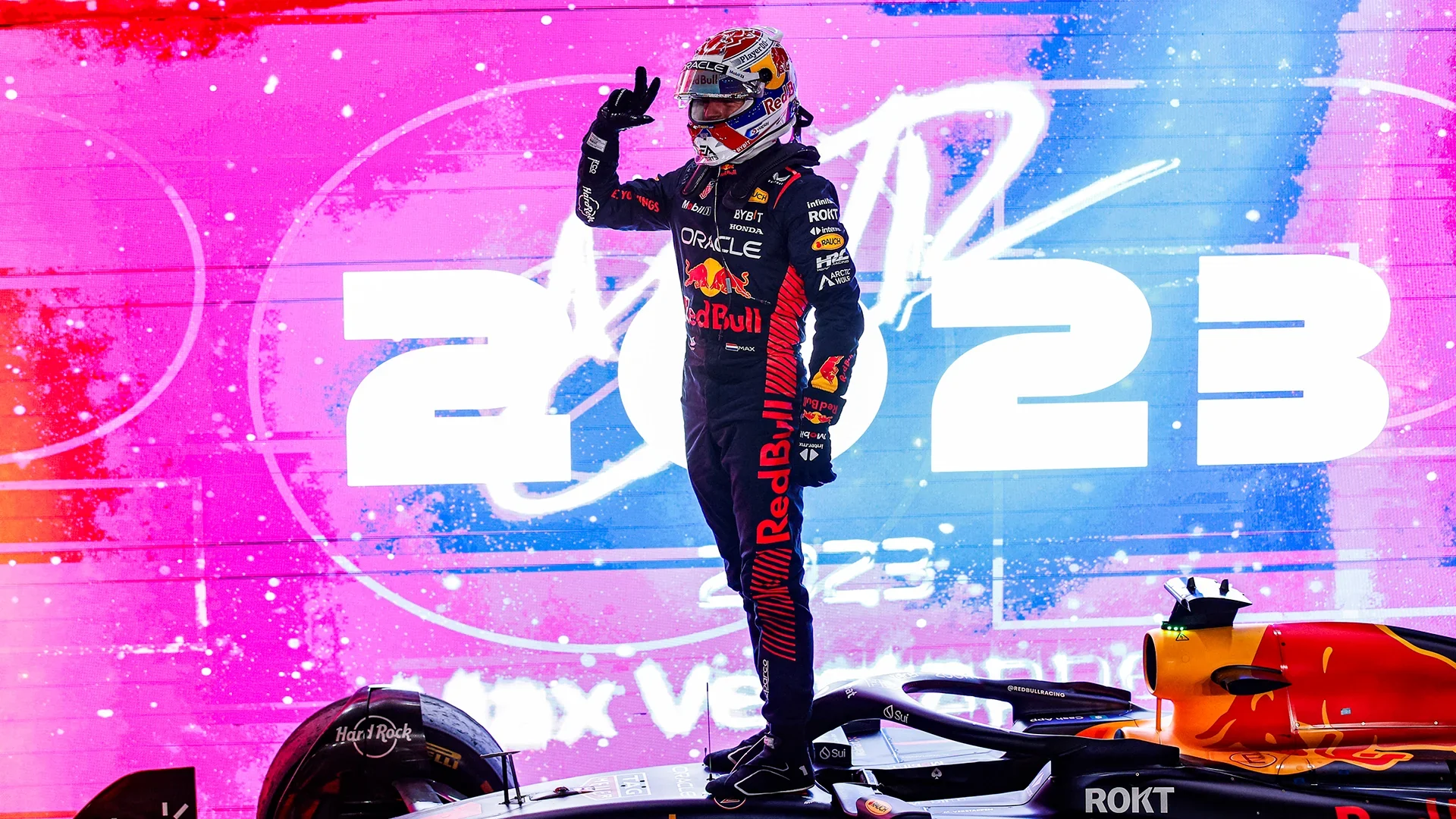
Max Verstappen won the 2023 F1 championship with 575 points, ahead of Sergio Perez on 285 and Lewis Hamilton on 234. Red Bull took the constructors' title with 860 points, while Mercedes beat Ferrari to second by just three. Those two gaps capture the season: extraordinary control at the front and much closer competition behind it.
The tables below show the final official order after Abu Dhabi, including all 22 drivers who competed during a 20-car season. They use the team identities from 2023 and include the consequences of the final classifications. The analysis explains how development swings, Sprint points, substitutions and post-race decisions shaped those totals.
This is a historical season review, checked against the official records on October 19, 2026. For the ongoing championship, visit the separate current F1 standings.
2023 F1 final driver standings
Verstappen finished 290 points ahead of Perez, while Hamilton was the highest-placed driver from another team. Behind them, fourth through seventh were separated by only six points. The final order is therefore much less uniform than the champion's enormous margin initially suggests.
| Pos. | Driver | 2023 team | Points |
|---|---|---|---|
| 1 | Max Verstappen | Red Bull | 575 |
| 2 | Sergio Perez | Red Bull | 285 |
| 3 | Lewis Hamilton | Mercedes | 234 |
| 4 | Fernando Alonso | Aston Martin | 206 |
| 5 | Charles Leclerc | Ferrari | 206 |
| 6 | Lando Norris | McLaren | 205 |
| 7 | Carlos Sainz | Ferrari | 200 |
| 8 | George Russell | Mercedes | 175 |
| 9 | Oscar Piastri | McLaren | 97 |
| 10 | Lance Stroll | Aston Martin | 74 |
| 11 | Pierre Gasly | Alpine | 62 |
| 12 | Esteban Ocon | Alpine | 58 |
| 13 | Alexander Albon | Williams | 27 |
| 14 | Yuki Tsunoda | AlphaTauri | 17 |
| 15 | Valtteri Bottas | Alfa Romeo | 10 |
| 16 | Nico Hulkenberg | Haas | 9 |
| 17 | Daniel Ricciardo | AlphaTauri | 6 |
| 18 | Zhou Guanyu | Alfa Romeo | 6 |
| 19 | Kevin Magnussen | Haas | 3 |
| 20 | Liam Lawson | AlphaTauri | 2 |
| 21 | Logan Sargeant | Williams | 1 |
| 22 | Nyck de Vries | AlphaTauri | 0 |
Alonso finished fourth ahead of Leclerc on countback. Both scored 206 and both had three second-place Grand Prix finishes. Alonso then prevailed on third places, five to Leclerc's three. A table that shows only the points can make that order look arbitrary; the finishing record resolves it.
Ricciardo and Zhou also ended level, on six. Ricciardo's seventh place in Mexico gave him the better highest finish, ahead of Zhou's ninth-place results. These are championship classifications, so the ordered positions remain meaningful even when the totals are identical. Norris was a single point behind Alonso and Leclerc, with Sainz five further back.
The numbers should be read as championship output across the opportunities each driver actually had. They incorporate the competitive level of the car, reliability, execution and scoring rules. They do not give a clean experiment in driver ability. Ricciardo and Lawson, in particular, contested only parts of the season, making an unqualified comparison with a full-season teammate misleading. Their appearances still belong in the complete final record.
The table uses familiar constructor names for readability while retaining the identities that raced in 2023. AlphaTauri and Alfa Romeo should not be silently relabeled with names adopted in later seasons: doing so can obscure which organization supplied those specific results.
2023 F1 final constructor standings
Red Bull's 860 points put it 451 clear of Mercedes. Farther down, McLaren finished 22 ahead of Aston Martin, while Williams survived a late AlphaTauri challenge by three. These margins describe three very different kinds of season: a dominant champion, an evolving upper midfield and a fight in which a single minor points finish could decide a position.
| Pos. | Constructor | Points |
|---|---|---|
| 1 | Red Bull Racing Honda RBPT | 860 |
| 2 | Mercedes | 409 |
| 3 | Ferrari | 406 |
| 4 | McLaren Mercedes | 302 |
| 5 | Aston Martin Aramco Mercedes | 280 |
| 6 | Alpine Renault | 120 |
| 7 | Williams Mercedes | 28 |
| 8 | AlphaTauri Honda RBPT | 25 |
| 9 | Alfa Romeo Ferrari | 16 |
| 10 | Haas Ferrari | 12 |
Constructor points aggregate the drivers who scored for that entrant. AlphaTauri's 25 came from Tsunoda's 17, Ricciardo's six and Lawson's two; de Vries contributed none. Changes in the cockpit do not create a new constructor account. That is why the driver table has more rows than twice the number of teams.
Williams illustrates the significance of converting a car's strengths into results. Albon scored 27 of its 28 points, including seventh places in Canada and Italy. Those two finishes supplied 12 points, a major share of the total. The team did not need to be the seventh-fastest car at every circuit to finish seventh in the championship; it needed to turn suitable weekends into results and defend them when possible.
Alpine ended sixth with 120, comfortably above the lower four teams but far below Aston Martin. Both Alpine drivers reached the podium during the year, yet occasional peaks did not amount to a sustained challenge to the group above. The same table can therefore reward a team for a memorable Sunday while still exposing the gap in season-long scoring capacity.
For Mercedes and Ferrari, the three-point difference is too small to describe with a single sweeping claim about whose car was better everywhere. Their positions came from the sum of two drivers' results across different tracks and competitive phases. Understanding that sum requires looking at the weekends where opportunities were gained, lost or altered after the finish.
How Verstappen and Red Bull made the title race one-sided
Red Bull won 21 of the 22 Grands Prix. Verstappen supplied 19 of those victories, Perez the other two. That concentration of wins is the foundation of the final table, but it still leaves an important distinction between having the fastest package and executing almost every opportunity it offers.
The championships were settled before the finale
Red Bull secured the constructors' title in Japan on September 24. Verstappen's third drivers' title followed during the Qatar Sprint on October 7: Perez's retirement removed the remaining mathematical threat, and Verstappen finished second behind Sprint winner Piastri. Neither championship depended on the Abu Dhabi finale.
Verstappen's ten consecutive Grand Prix victories from Miami through Italy turned the season's early Red Bull contest into a sustained run of control. Perez had won in Saudi Arabia and Azerbaijan, showing that the opening phase was not simply a procession behind one teammate. Over the full year, however, Verstappen repeatedly turned the available performance into victories while Perez's scoring became less consistent.
The 290-point gap is therefore more than a statement about the car's advantage over other constructors. It also reflects the disparity in results within the same team. It would still be too simplistic to use the total as a measurement of pure driving speed: compromised qualifying sessions, reliability and race circumstances affect the opportunities from which points are earned.
Race pace mattered beyond pole position
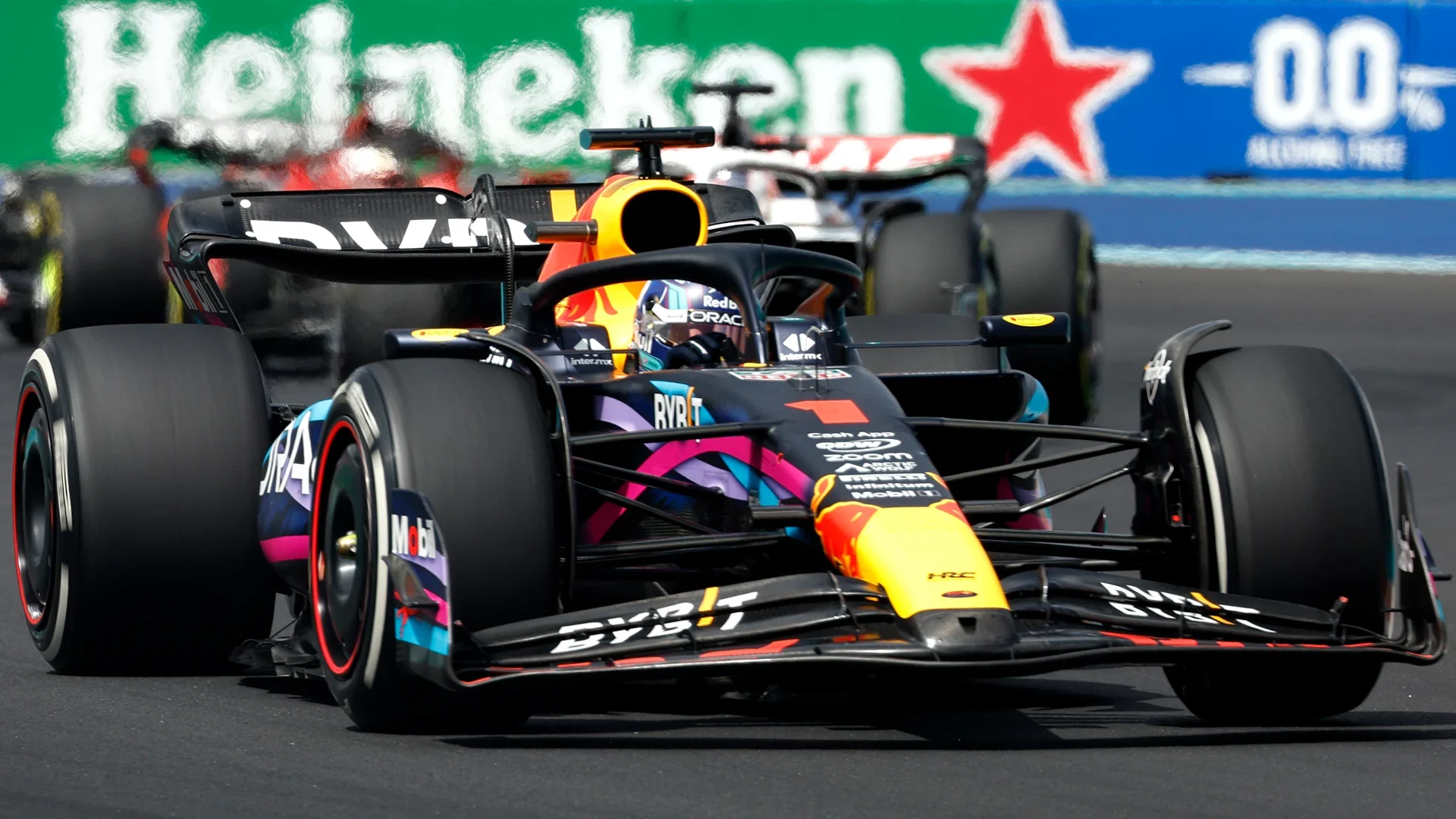
Miami supplies a concrete example of the champion's ability to recover a weekend. Verstappen started ninth on hard tires, while polesitter Perez began on mediums. A long opening stint allowed Verstappen to exploit clear air and preserve a strong pace before switching compounds. He won despite starting well behind his teammate.
The mechanism was more specific than simply choosing the harder tire. Extending a stint only helps if the tire remains competitive and the driver avoids losing too much time behind traffic. The eventual stop also has to fit the time lost through the pit lane and the pace available afterward. Red Bull and Verstappen converted those pieces into a race-winning strategy; the compound choice alone did not guarantee it.
Suzuka demonstrated the other side of the same strength. Verstappen could lead from the front and manage a demanding race while Red Bull completed the title. The broader interpretation is that the RB19-Verstappen combination could win through different routes. That made a bad grid position less damaging and reduced the number of weekends on which rivals could capitalize.
Why the order behind Red Bull kept changing
The final constructor order is an accumulation, not a snapshot of the last race. Teams brought different levels of performance to the beginning, middle and end of the season. That is especially important when interpreting the four constructors immediately behind Red Bull.
Mercedes edged Ferrari by three points
Mercedes finished second without winning a Grand Prix. Ferrari took the only non-Red Bull victory, through Sainz in Singapore, yet ended third. The explanation starts with the scoring across both cars: Hamilton contributed 234 and Russell 175, compared with Leclerc's 206 and Sainz's 200.
Ferrari's landmark win was worth the same 25 winner's points as any other Grand Prix victory. It could not outweigh every opportunity lost elsewhere. Equally, Mercedes' second place did not mean it had solved the performance deficit to Red Bull. It established the stronger combined total over the full calendar, by a margin small enough for routine points positions to matter.
Russell's Abu Dhabi podium supplied a particularly visible final contribution. It should not be treated as the sole cause of the outcome: with only three points between the teams, many earlier weekends could be used to construct a different counterfactual. The useful lesson is that a constructors' campaign demands conversion from both cars, even when race wins are unavailable.
McLaren caught Aston Martin after a slow start
McLaren's fourth place tells little about how badly the year began. Its major midseason development sequence changed the competitive picture: Norris finished fourth in Austria, then he and Piastri qualified second and third at Silverstone. Norris held second in the British Grand Prix, while Safety Car timing helped leave Piastri fourth rather than joining him on the podium.
The improvement created repeated high-value scoring opportunities. Norris reached 205 points and rookie Piastri 97, giving McLaren 302. Aston Martin finished on 280, with Alonso's 206 making up the larger share alongside Stroll's 74. Alonso's eight podiums demonstrated how strong Aston Martin could be, especially early in the year; the team still lost the season-long comparison to McLaren.
This is why the driver and constructor orders should be read together. Alonso beat Norris by one point, yet McLaren beat Aston Martin by 22. A stronger contribution from the other car can reverse the team outcome. Development progress also changes the available opportunity: a team collecting podium-level points late in the year can recover ground even after an expensive early deficit.
Three weekends that explain the final table
Some weekends matter because they reveal a car's strength; others matter because strategy or a formal decision changes the score. Singapore, Austin and Abu Dhabi supply a compact route through those different mechanisms.
Singapore broke Red Bull's winning run
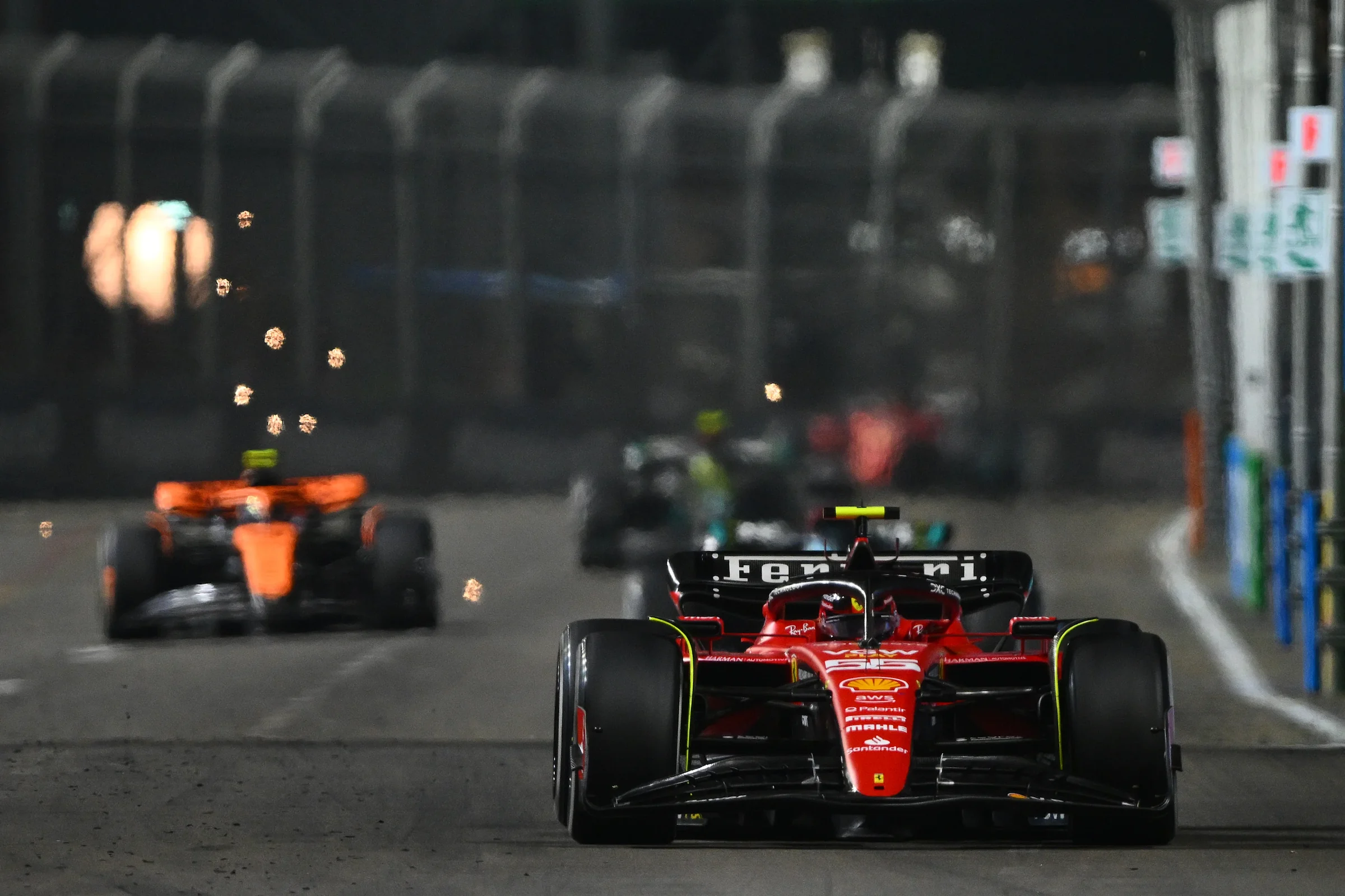
Sainz won from pole at Marina Bay, the only Grand Prix victory by a team other than Red Bull all year. His closing defense was especially instructive. Mercedes put Russell and Hamilton onto fresh medium tires under a Virtual Safety Car, creating a late pace threat to Sainz and Norris ahead.
Sainz kept Norris close enough to benefit from DRS, helping the McLaren defend against the Mercedes pair. That protected the Ferrari's position by making it harder for the fresher-tired cars to reach the leader. Russell crashed on the final lap, leaving Norris second and Hamilton third. The race demonstrated that tire advantage still needs a route past traffic, and that controlling gaps can be as important as producing the fastest isolated lap.
Austin changed after the checkered flag
Hamilton and Leclerc were disqualified from the United States Grand Prix after their cars failed the post-race plank-wear checks. The FIA decision concerned technical compliance under the 2023 regulations. Their finishing positions were removed from the race result; this was not simply a separate deduction applied to an otherwise unchanged championship table.
Norris consequently became second and Sainz third, while Sargeant gained tenth and his first championship point. The published final standings already reflect those changes. Keeping Hamilton's on-road second place in a reconstructed season total would double-count a result that was not retained.
The teams pointed to the combination of the bumpy circuit and limited preparation time on a Sprint weekend when discussing the wear. That explanation did not change the compliance requirement. It also does not establish deliberate wrongdoing or disclose an exact ride-height choice. The important statistical distinction is that the Grand Prix exclusions did not erase the separate Sprint classification.
Abu Dhabi settled the remaining battles
Verstappen won the finale, while Leclerc attempted to influence the constructors' fight behind him. Perez carried a five-second penalty for a collision with Norris. Leclerc let the Red Bull through in the hope that Perez could build enough of a gap to demote Russell after the penalty was added.
The gap was insufficient. Leclerc was classified second, Russell third and Perez fourth. Hamilton's ninth place supplied two additional points, taking Mercedes to 17 for the race; Ferrari scored Leclerc's 18. Mercedes' four-point pre-race advantage therefore became a three-point final margin. That arithmetic, based on the penalty-adjusted classification, is the explanation for the team order.
Alonso's seventh place also completed his 206-point total and secured fourth on countback ahead of Leclerc, with Norris just one point behind both. The champions had long been known, yet the final race still changed how several closely matched campaigns were ordered.
How Sprints, penalties and substitute drivers affect the numbers
A final championship total cannot be reconstructed by multiplying wins and podiums by a single score. The 2023 season included separate Sprint classifications and a fastest-lap bonus, while replacements meant some drivers had fewer chances to score. Those details are essential when comparing closely matched totals.
Grand Prix wins and Sprint wins are different records
Under the 2023 rules, a normal full-points Grand Prix awarded 25, 18, 15, 12, 10, 8, 6, 4, 2 and 1 to the top ten. The driver setting the fastest valid race lap earned an additional point only if classified in the top ten. Pole position itself carried no championship points.
The six Sprints awarded eight points to the winner, descending to one for eighth, without a fastest-lap bonus. Those points contributed to the same drivers' and constructors' championships. A weekend total could therefore exceed the points attached to the driver's Grand Prix finishing position alone.
Piastri's Qatar success was a Sprint victory. It did not add a Grand Prix win to McLaren's record or reduce Red Bull's 21-of-22 Grand Prix tally. Distinguishing the records allows both statements to be true: McLaren won a competitive F1 session in 2023, and Ferrari was the only team to beat Red Bull in a Grand Prix. The final totals also already include exclusions and adjusted classifications, so those consequences should not be subtracted a second time.
Why 22 drivers appear in a 20-car championship
AlphaTauri accounts for the extra names. De Vries contested the opening ten Grands Prix, before Ricciardo replaced him from Hungary. Ricciardo then broke a hand during Dutch Grand Prix practice, bringing Lawson into the car. Lawson raced from the Netherlands through Qatar, and Ricciardo returned in Austin. Tsunoda occupied the team's other regular seat.
Each driver retained his own championship points; they were not transferred to the next occupant of the cockpit. The constructor accumulated the scores earned for it. That produces four AlphaTauri drivers in the final championship table while the team continued to enter two cars.
It also limits what the standings alone can prove about the substitutes. Lawson's two points and Ricciardo's six came from different portions of a season in which the car and competitive order evolved. Opportunity count, circuit mix and adaptation time belong in a serious comparison. The final positions record what happened; they do not normalize those conditions automatically.
What the 2023 standings reveal about the season
The season is best understood through three related questions: how much performance a team had, how that performance changed, and how often its drivers turned an opportunity into a result. Red Bull answered all three strongly enough to remove the title contest early. The teams behind it supplied contrasting answers rather than one consistent second-best car.
Haas offers a particularly clear warning against judging a season from qualifying highlights. The VF-23 could put Hulkenberg into Q3, yet longer-stint tire degradation repeatedly undermined its race performance. A good starting position did not remove the need to sustain pace over the stint. Finishing tenth in the constructors' table was therefore compatible with conspicuous single-lap speed.
Alpine shows the difference between reaching a podium and accumulating front-running results. Ocon finished third in Monaco and Gasly third in the Netherlands. Those successes mattered, but the team's 120 points still left it a long way behind the five constructors above. A season can contain excellent individual races without supporting a higher overall position.
The closest comparisons require equally careful reading. Alonso and Leclerc needed countback; Norris finished a point behind them; Mercedes and Williams each protected a three-point advantage over a neighboring team. In those contests, a minor finish, a Sprint score or an adjusted classification could have lasting significance. The final order is precise even when a broad claim about relative ability would be less defensible.
For a focused rewatch, Miami explains how race pace and an alternative stint plan can overcome the grid, Singapore shows how position and gap management can defeat a tire threat, and Abu Dhabi shows why the classified result controls the championship arithmetic. Together, they connect the tables to the decisions that made 2023 more than a list of Verstappen victories.
Loading comments…