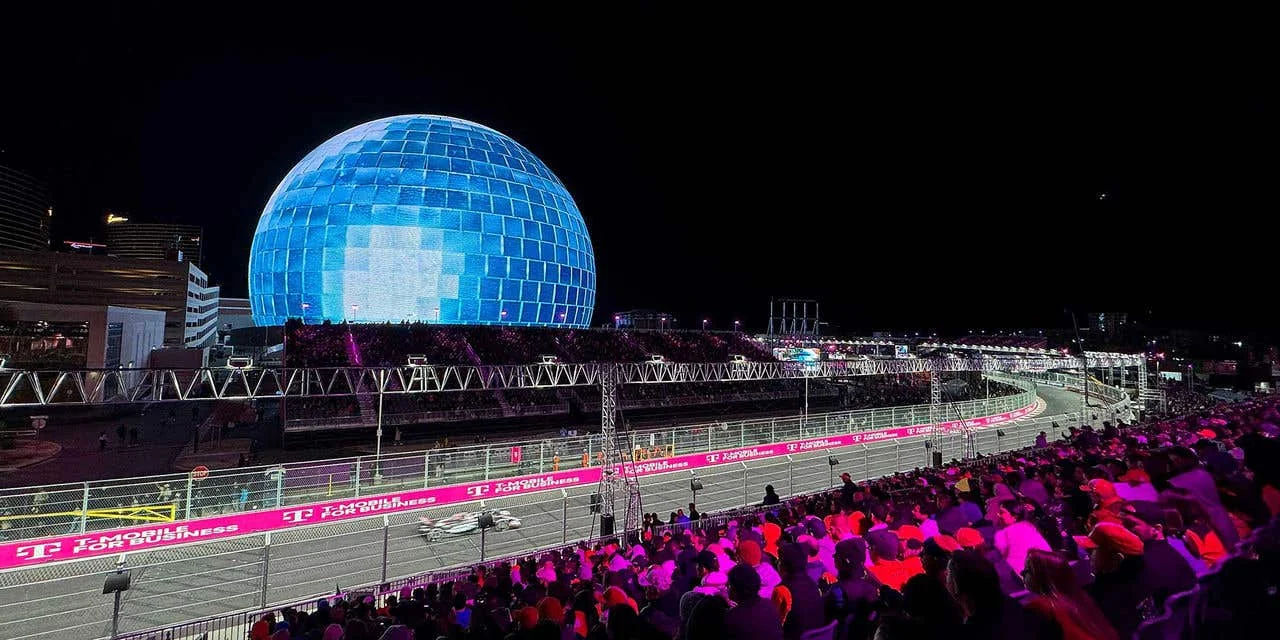
A Las Vegas F1 track map is useful only if you know which question it answers. The circuit drawing explains where the cars go. A seating plan explains where you watch them. An event-access map explains how you reach the entrance your ticket actually permits. Confusing those three layers can turn a hotel that looks perfect on a booking screen into a long detour on race night.
The 2026 Las Vegas Grand Prix takes place November 19–21, with the race on Saturday night. This guide, checked October 14, connects the circuit’s racing geography to grandstands, nearby hotels and entrance planning. It does not assign an unannounced gate number or turn an old pedestrian route into a 2026 promise. Use the organizer’s current maps and your ticket instructions for that final step.
If you are still comparing admission costs, start with our Las Vegas 2026 ticket guide. Here, the question is what your location lets you see and how you get there. A good choice should preserve both the racing experience and enough time to enjoy it.
Start with the right Las Vegas F1 map
Begin with the organizer’s circuit layout, then move to the live ticket product and the official event wayfinding tool. These pages have different jobs. A brightly colored stand block establishes a general location; it does not establish that every nearby sidewalk leads to its security entrance. Treat the year printed on a downloaded image as a condition of using it, especially when comparing screenshots shared by previous attendees.
Circuit layout, seating map and access map answer different questions
A circuit map follows the racing lap and its corner sequence. A seating map adds ticket areas, sections and sometimes a seat-view preview. An access map adds the parts a pedestrian needs: permitted approaches, crossings and the destination entrance. You may need all three, but a single screenshot rarely does all three accurately. Make the ticketed zone your anchor and check other layers around it.
| Map layer | Use it to decide | Do not assume |
|---|---|---|
| Circuit | Corner, straight and pit geography | Public access along the racing line |
| Seating | Your section and likely viewing direction | Entry to every adjacent ticket zone |
| Event access | A permitted route to your entrance | A route unchanged for the whole week |
What Google Maps cannot tell you on race weekend
Google Maps remains useful for identifying hotels, transit stations and the wider city. Its everyday walking estimate is not proof that an event-controlled crossing is available to you at that hour. Search a hotel’s actual pedestrian exit, rather than relying only on its central map pin, then compare that route with event instructions. The extra check matters most when the track separates two places that look close together.
The official F1 Las Vegas app combines wayfinding with ticket management and event updates. Keep a saved overview for orientation, but refresh the official route before departure. A static map is your memory aid; current operating instructions decide whether a crossing or entrance is usable. That distinction helps you spend the evening watching cars rather than retracing a route.

Read the lap before choosing your grandstand
The Las Vegas Strip Circuit is a long street-course lap with very different viewing experiences around it. A seat close to a famous hotel can be excellent for atmosphere while giving you only a brief glimpse of each car. A less glamorous corner can give you more time to follow a braking point, change of direction or exit. Choose the part of a lap you most enjoy studying before choosing the background for your photograph.
The start-finish area rewards race-operations watchers
The Heineken Silver Main Grandstand is the obvious starting point for fans who want the grid, start-finish activity and pit-stop context. A pit stop can change a race without producing an immediate pass at your corner. Watching a car disappear into the lane and rejoin, while following the timing screen, makes the undercut or an unsuccessful stop feel less abstract. The appeal is the combination of operations and race ceremony.
That does not mean every seat has the same view of every garage. Section, row, angle and temporary structures all matter. Use a seat preview for the exact block and ask about the parts you care about: grid, pit lane, first corners or finish. A broad product description should start your shortlist; it should not replace checking the seat itself.
Sphere and the Strip offer different kinds of racing views
T-Mobile Grandstands are associated with Turn 5 and the Turns 7–9 chicane, giving this part of the map a strong corner-sequence identity. Here the attraction is watching how a driver sets up successive changes of direction. Compare the approach, the car’s position through the sequence and the exit rather than expecting every visit to produce an overtake. A screen remains useful because the consequence can develop farther around the lap.
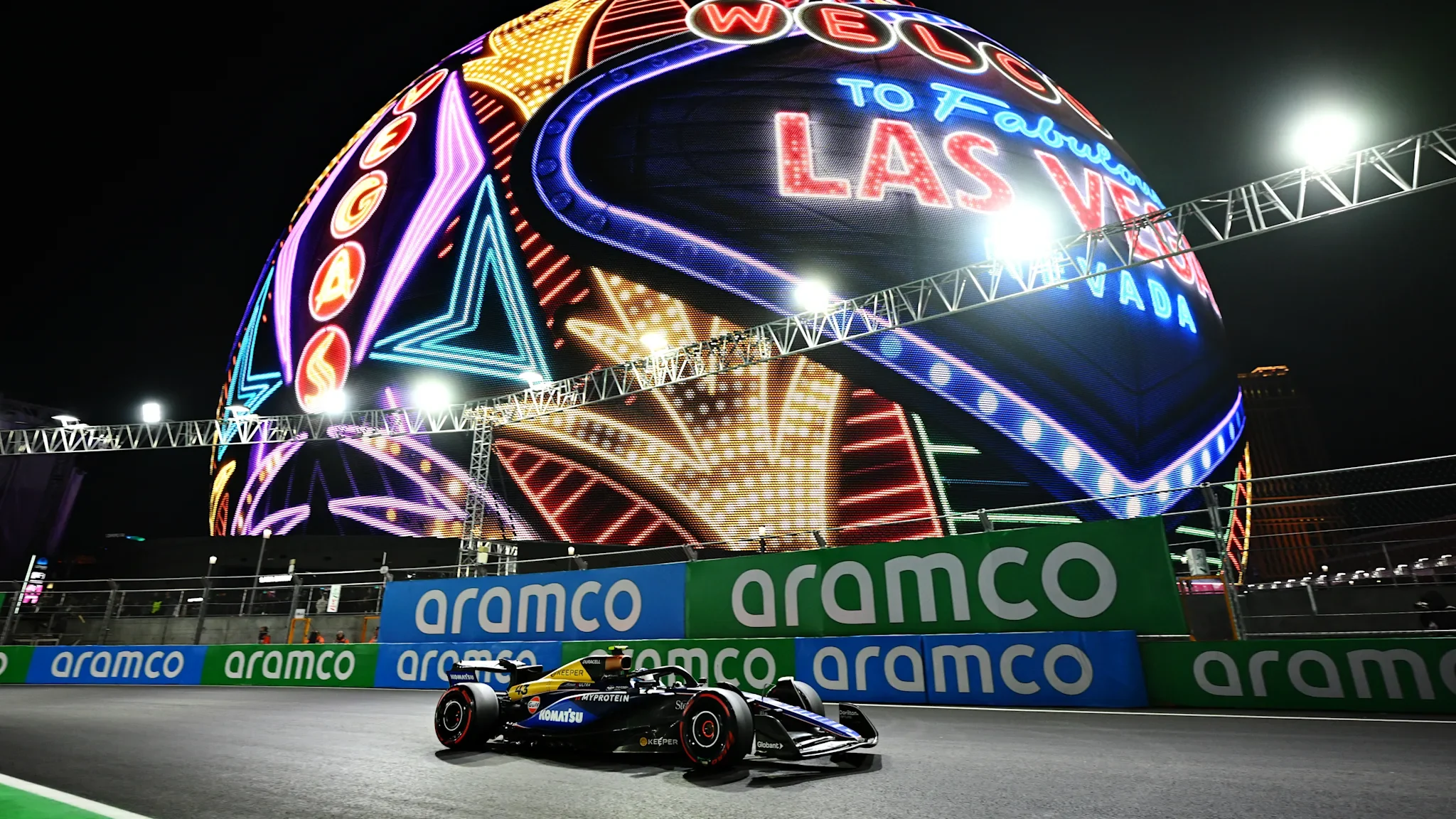
Along the Strip, the appeal changes toward speed, recognizable landmarks and the city backdrop. Straight-line viewing can be spectacular, but the cars pass quickly. Fans seeking sustained corner observation should compare it carefully with a slower sequence. Neither preference is wrong: one emphasizes the physical speed of Formula 1, the other makes the driver’s line easier to follow. The important point is choosing deliberately.
The final corner connects a lap to a pit decision
The Lewis Hamilton Grandstand Package is located in West Harmon by Turn 17. That makes the closing part of the lap the viewing reference rather than the Sphere-side sequence. For a fan following strategy, the interest includes how a driver finishes the lap and approaches the pit decision. Check the exact seat-view illustration before assuming the whole entry or pit lane is visible.
One practical test is to describe your preferred view without naming a hotel: “I want to watch changes of direction,” “I want start and pit-stop context,” or “I want the end of the lap.” Once that preference is clear, the circuit map narrows the ticket search. It also prevents a common mistake: paying for a famous location whose racing view does not match the reason you came.
Match the 2026 ticket zone to the experience you want
Read the ticket name as a combination of view and access rights. An assigned grandstand seat gives you a defined place to return to between activities. General admission changes that rhythm: the viewing position is part of the evening’s planning, rather than a numbered seat waiting for you. For a group, that difference affects whether everyone can explore separately and reunite easily before the session.
The 2026 Turn 3 Grandstand has moved to the west side of its corner, according to the organizer’s current product description. That is a concrete reason to reject an old map as your only seating reference. The name can stay familiar while the viewing angle changes. Compare the current illustration with the exact seat block offered, especially if your choice is based on a photograph from another year.
Check the 2026 zone-access change
West Harmon, East Harmon and Koval are connected for the ticket products whose current inclusions specify that access. This is an important 2026 change. Blanket advice that Las Vegas tickets always restrict you to one isolated zone is too crude for the current offering. Equally, the connection does not mean every admission grants entry to every grandstand, hospitality suite or the separate T-Mobile Zone at Sphere.
Treat access to an activity area and access to a seat as separate permissions. A connected fan zone lets you reach listed entertainment and activations; it does not convert a West Harmon assigned seat into a Main Grandstand seat. The value is being able to explore and return to your own racing position. Look for the explicit inclusion on your product, not a rule inferred from a map’s colors.
For a racing-focused visit, choose the view first and use the extra zones around it. For a festival-focused visit, compare the entertainment attached to the permitted zone before choosing your viewing type. Neither approach requires chasing the largest footprint. A smaller plan you can execute comfortably is more useful than a list of activities that conflicts with the session you most want to watch.
Choose a hotel by its usable route, not its map pin
A hotel overlay is a useful first filter, but frontage and access are different things. The building’s map pin might represent a lobby, a tower or the center of a large resort. Your usable exit could be elsewhere. Before paying extra for proximity, establish which hotel exit you will use and which event entrance it connects to. The shortest distance on paper is not automatically the simplest journey.
Compare the Sphere-side and Harmon-side hotel areas
The Venetian’s 2026 Grand Prix page explicitly links its hotel offering to T-Mobile Zone at Sphere grandstand access. That is useful geographical alignment for a Sphere-zone ticket. It is not evidence that every other zone is equally convenient from the same room. A hotel associated with one spectator area should be evaluated again if you change your ticket to another part of the circuit.
For a Harmon-side ticket, compare the approach to the actual entrance rather than shopping only for a central Strip address. Put the permitted crossing, if one is needed, between the hotel and the entrance on your plan. Then consider the return journey after the session. A route that feels reasonable in daylight may be less appealing when the group is tired and everyone is leaving together.
You can make the comparison without inventing walking times. Shortlist two hotels, identify their practical pedestrian exits, locate your ticket’s access destination and check the event route. Ask each property about race-week arrival and departure instructions. For a traveler with mobility needs, an elevator-dependent crossing and a step-free alternative are part of the comparison, not details to solve after check-in.
A track-view room is a separate product
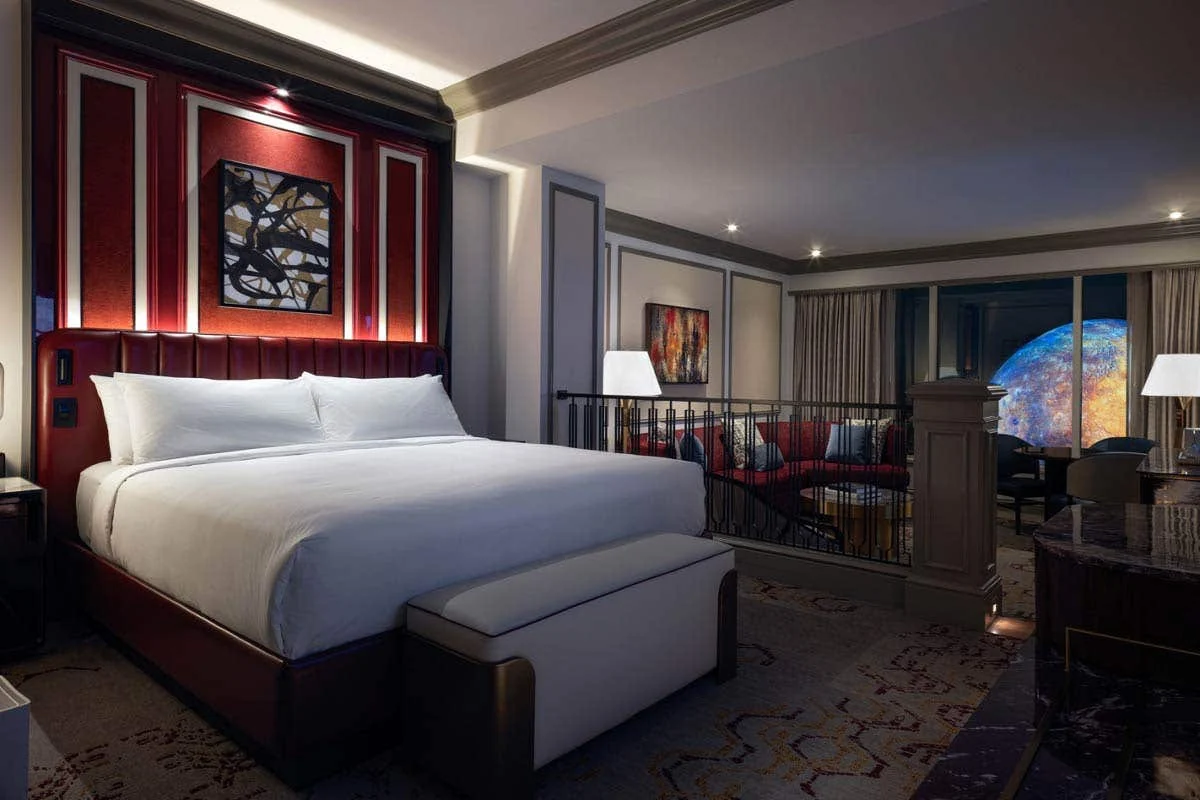
“Near the track,” “Strip view” and “race view” are different booking claims. A room can face the correct street but miss the racing surface because of its floor, angle or an intervening structure. Ask for the exact room category and the promised view in writing. If seeing cars from the room is the point of the booking, do not leave the decisive detail to a general hotel photograph.
Also separate the room from a hotel’s viewing platform, hospitality invitation or ticket bundle. The Venetian describes a VIP platform as invitation-only; booking accommodation does not automatically establish access. The organizer’s hotel directory is a starting point for accommodation research, while the individual offer defines what you actually buy. A clear package lists the room, nights, ticket zone and eligible guests. An attractive map pin cannot supply a missing inclusion.
Verify your entrance and crossing before leaving the hotel
The organizer’s 2026 A-Z guide says zone-entrance details will be shared with ticket holders through their mobile ticket, with the official app providing walking routes and wheelchair-accessible paths. That is the appropriate source for your gate. A previous attendee’s gate number is not a substitute, and a track drawing does not authorize you to approach from either side of the fence.
Before departure, read the admission product, zone and entry instructions together. If two people have different tickets, confirm that their entrances and permitted activity areas align before assuming they can enter as a group. If a ticket has been transferred, make sure the recipient can access the current instructions themselves. The useful map is the one that belongs to the ticket you will scan, not the screenshot sent by its previous holder.
Think of the journey as three separate legs: hotel exit to permitted crossing, crossing to security entrance, and entrance to the seat or viewing area. A route can succeed on the first leg and fail on the second. For example, a couple might reach the correct side of a hotel complex but discover their usual onward shortcut is event-controlled. Checking the final destination and authorized approach in advance avoids treating arrival near the circuit as arrival at the gate.
For an accessible visit, save the designated step-free route rather than assuming every pedestrian bridge is an interchangeable option. Ask the event accessibility team about your particular seat and path if the instructions leave a gap. The organizer describes accessible routes and services within the event, but those provisions do not remove the need to check the journey from your hotel. The outward and return legs deserve the same attention.
Finally, choose a regrouping point that is permitted for everyone in your party. “Meet beside the circuit” is too vague for a long street-course perimeter. A specific public hotel location or an activity point inside a zone everyone can access is easier to execute. Keep the message short enough to find on your phone, and update it if the official route changes. Clear instructions protect the session time you have already paid to see.
Build one practical map for your race night
Your final plan can be much simpler than a full circuit overlay. Save the information that connects your accommodation to your own ticket: the hotel exit, entrance label, permitted route and destination section. Add the official map link so a saved picture does not become your only source. A personal checklist is useful precisely because it leaves out the many attractive locations your admission does not cover.
- Confirm the ticketed day, product, zone and section in your own account.
- Save the actual hotel exit you intend to use, rather than only the hotel’s central pin.
- Check the current official approach and any crossing required to reach your assigned entrance.
- Record the seat or viewing-area destination after security, plus a meeting point everyone can reach.
- Plan the return journey and one permitted alternative if your first route changes.
- Refresh the event instructions and the date-specific transportation map before you leave.
Then work backward from the session you want to see. Leave room for the parts an everyday walking estimate cannot capture: moving through a large hotel, checking the approach, admission and finding your position. These are planning allowances, not a promised queue duration. If you also want driver interviews or music, put them around the racing session rather than hoping the circuit map will make every activity adjacent.
Use our weekend schedule for the racing timetable when Las Vegas comes around. Keep the event app responsible for navigation and updates. That division gives you a coherent evening: the circuit layer explains what you are watching, the ticket layer establishes where you belong, and the access layer gets you there. A clear route and a view that fits your interests are more valuable than a complicated map full of pins.
Loading comments…