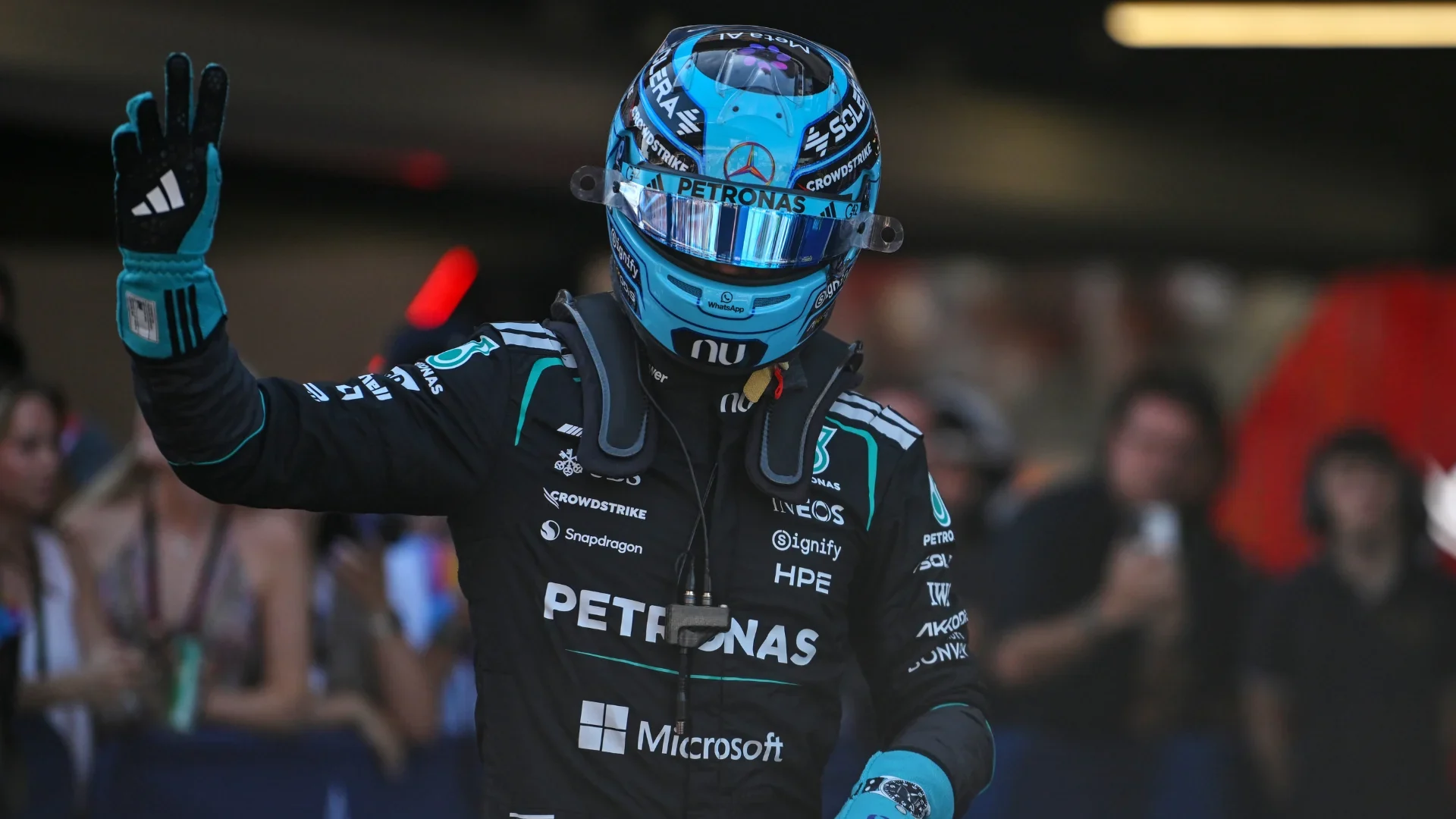
George Russell took pole for the 2026 Barcelona-Catalunya Grand Prix with a 1:14.679 lap, beating Lewis Hamilton by 0.064 seconds and Mercedes team-mate Kimi Antonelli by 0.319. The session's defining interruption came when Charles Leclerc crashed at Turn 4 early in Q3 and failed to record a time in the final segment.
This is the June 13 qualifying result from Circuit de Barcelona-Catalunya, not the separate September Spanish Grand Prix at Madrid. Below you will find all 22 drivers, the progression through each knockout phase, the evidence behind Russell's pole, and the performances that reshaped the midfield. For the site's compact data view, open the latest F1 qualifying results; for the full event context, use the Barcelona-Catalunya race page.
The classification captures Saturday pace, not the race outcome. It nevertheless delivered a revealing snapshot: Mercedes locked two of the first three places, Hamilton returned to the front row, and several expected contenders faced unusually difficult afternoons.
Barcelona 2026 Qualifying Result at a Glance
Russell's 1:14.679 put Mercedes on pole and completed a weekend pattern: the Briton had also topped first and third practice. Hamilton's final lap moved Ferrari onto the front row, only 0.064 seconds short. Antonelli took third on 1:14.998, narrowly ahead of Norris, whose 1:15.001 missed the Mercedes rookie by three thousandths.
Verstappen and Hadjar formed a Red Bull lockout of the third row in fifth and sixth. Piastri qualified seventh for McLaren, followed by two midfield standouts: Lawson in the Racing Bulls and Hülkenberg for Audi. Leclerc was classified tenth after reaching Q3 but crashing before setting a valid time in the segment.
Pole
George Russell
Pole lap
1:14.679
Front-row gap
0.064 seconds
The result mattered beyond the first row. Ferrari split the two Mercedes cars, while neither McLaren reached the top three. Aston Martin placed both home favorite Fernando Alonso and Lance Stroll on the back row. In between, a handful of teams converted small margins into valuable track position, making the complete classification more informative than the pole headline alone.
The Complete Qualifying Classification
The decisive time shown below is each driver's best lap in the segment that fixed the position. Q3 drivers are ordered by Q3, Q2 eliminations by Q2 and Q1 eliminations by Q1. That is why times across the three groups should not be compared as one uninterrupted ranking.
Q3 Top 10
| Pos. | Driver | Team | Q3 |
|---|---|---|---|
| 1 | George Russell | Mercedes | 1:14.679 |
| 2 | Lewis Hamilton | Ferrari | 1:14.743 |
| 3 | Kimi Antonelli | Mercedes | 1:14.998 |
| 4 | Lando Norris | McLaren | 1:15.001 |
| 5 | Max Verstappen | Red Bull | 1:15.021 |
| 6 | Isack Hadjar | Red Bull | 1:15.077 |
| 7 | Oscar Piastri | McLaren | 1:15.090 |
| 8 | Liam Lawson | Racing Bulls | 1:16.542 |
| 9 | Nico Hülkenberg | Audi | 1:16.657 |
| 10 | Charles Leclerc | Ferrari | No time |
The Q3 table contains two distinct battles. Russell and Hamilton separated themselves at the front, while only 0.092 seconds covered Antonelli in third through Piastri in seventh. That second cluster meant a tiny improvement could have moved a driver several places. Lawson and Hülkenberg were farther back on their final-segment laps, yet their presence in Q3 ensured they stayed ahead of all Q2 eliminations.
Leclerc's “No time” should not be read as failure to participate in qualifying. His Q2 performance had already earned a Q3 place. The crash prevented a valid time in that final group, so he was classified behind the nine drivers who did record one but ahead of the drivers eliminated before Q3.
Q2 Eliminations: Positions 11–16
Lindblad missed Q3 by less than a tenth to Hülkenberg. Bortoleto followed in P12, while Colapinto beat Alpine team-mate Gasly. Bearman and Sainz completed the Q2 elimination group.
- 11. Arvid Lindblad — 1:15.840
- 12. Gabriel Bortoleto — 1:16.001
- 13. Franco Colapinto — 1:16.191
- 14. Pierre Gasly — 1:16.261
- 15. Oliver Bearman — 1:16.389
- 16. Carlos Sainz — 1:17.827
This group also explains why Sainz appears behind Bearman even though Sainz's Q1 time had been quicker than several cars. Every advancing driver starts Q2 with a clean slate; Sainz's 1:17.827 in Q2, not his earlier lap, determined P16. Colapinto's P13 gave Alpine the intra-team advantage over Gasly, while Bortoleto's P12 left Audi with one car in each of the Q2 and Q3 cohorts.
Lindblad's P11 was the painful cut-line result. He had progressed comfortably from Q1 but could not match Hülkenberg when the decisive Q2 laps arrived. A difference measured in less than a tenth separated a Q3 appearance from the best position outside it.
Q1 Eliminations: Positions 17–22
Ocon was the first driver outside the Q2 cut. Albon joined him on row nine of the provisional order, followed by the two Cadillacs. Aston Martin endured the starkest disappointment: Stroll and Alonso filled positions 21 and 22.
- 17. Esteban Ocon — 1:17.073
- 18. Alexander Albon — 1:17.424
- 19. Sergio Perez — 1:17.545
- 20. Valtteri Bottas — 1:17.757
- 21. Lance Stroll — 1:18.758
- 22. Fernando Alonso — 1:18.815
Ocon became the reference for the first cut: everyone faster advanced, while these six were locked into the rear cohort. Albon's failure to join Sainz in Q2 produced a split Williams result. Cadillac lost both cars together, Perez leading Bottas, and neither Aston Martin found the improvement needed to threaten the cut.
The raw Q1 gaps were unusually severe at the back. Stroll was more than a second slower than Ocon, with Alonso another 0.057 behind. Qualifying position alone cannot diagnose the technical cause, but it clearly shows the scale of Aston Martin's Saturday deficit relative to the final driver who nearly advanced.
One further reading rule helps connect all three tables. A driver's displayed decisive lap answers how that driver ranked within the final segment reached, not how fast the driver was at every point of the afternoon. Russell's pole lap is directly comparable with Hamilton's because both came from Q3. Lindblad's Q2 lap explains P11, but it cannot be inserted into the Q3 order even if it looks competitive beside a later time. Ocon's Q1 lap serves the same purpose for P17.
Conditions also changed between runs. Rubber accumulated, temperatures moved and the red flag interrupted Q3. The official classification correctly preserves the sporting outcome, while the session narrative supplies context for the figures. Reading both prevents two opposite errors: dismissing a strong Q3 appearance because its final time looks slow, or promoting an eliminated driver on the basis of an earlier segment.
How George Russell Secured Pole
Russell's pole was not a one-lap surprise. He had led two of the three practice sessions and carried that confidence into qualifying. The challenge was converting repeatable pace into the final run after a red flag changed the rhythm of Q3.
Mercedes Set the Pace Before the Final Runs
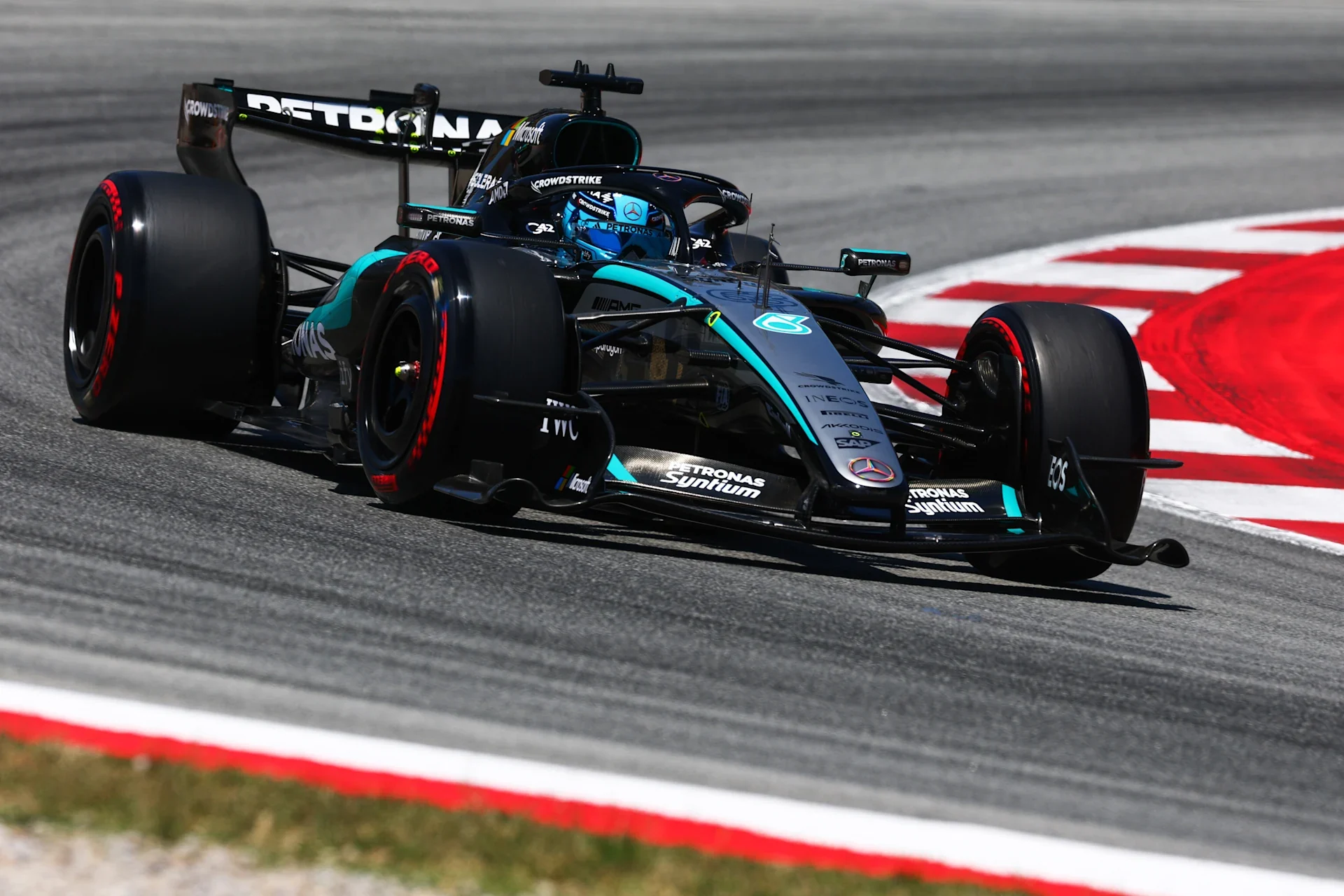
Hamilton edged the early Q1 benchmark, but Russell became increasingly authoritative as the session developed. His 1:15.228 led Q2, with only 0.067 seconds covering Russell, Leclerc and Antonelli at the front. That compressed margin showed Mercedes had speed but no safety cushion.
Barcelona's long corners punish a car that cannot sustain balance, while the final sector rewards traction and tyre condition. Russell repeatedly assembled the lap rather than relying on one standout micro-sector. His earlier practice performance also reduced the need for a desperate setup or driving change before Q3.
Russell’s 1:14.679 Lap and the Front-Row Gap
After Leclerc's red flag, Russell established provisional pole with a 1:15.145. Antonelli then moved ahead, forcing a response. Russell's final 1:14.679 found nearly half a second over his banker and proved unreachable. It was his third pole of 2026.
Hamilton's late 1:14.743 came closest, a margin of 0.064. The gap was small enough to emphasize execution rather than a dominant machinery advantage, but Russell had delivered precisely when the track and pressure peaked. Antonelli's 1:14.998 placed the second Mercedes third, confirming the team's broader qualifying strength even though Ferrari interrupted a front-row lockout.
For race analysis, pole also placed Russell on the cleaner strategic side of the opening sequence and gave Mercedes control over its first stint. Qualifying could not guarantee the outcome, but it maximized the team's options.
The Q3 Red Flag and the Fight Behind Russell
Q3 did not unfold as a clean sequence of two attempts. The early stoppage divided the session, removed Leclerc from contention and concentrated the remaining runs into eight minutes. Drivers had less freedom to choose their preparation gaps, increasing the value of a safe banker and a decisive final lap.
Charles Leclerc’s Turn 4 Crash
Leclerc had been among the leaders in Q1 and Q2, but his final segment ended before a representative time. The Ferrari snapped at Turn 4; Leclerc overcorrected, crossed the gravel and struck the barrier. Officials stopped the session so the car could be recovered and the circuit made safe.
Because he had reached Q3, Leclerc remained tenth in the qualifying classification even without a Q3 time. That detail is a useful example of the knockout format: the ten Q3 participants stay ahead of Q2 eliminations, while their internal ordering follows the final segment's classification rules.
Hamilton, Antonelli and a Three-Millisecond Margin
The restart left enough time for the front-runners to attack. Antonelli briefly displaced Russell, but Russell answered. Hamilton then produced the closest challenge on his last attempt, taking second and returning Ferrari to the front row.
Behind Hamilton, the fight was even tighter. Antonelli's 1:14.998 beat Norris's 1:15.001 by only 0.003 seconds. Verstappen was another 0.020 behind Norris. Those differences are smaller than a minor correction, a fractionally delayed throttle application or a compromised corner exit, illustrating why the Q3 order cannot be reduced to broad team pace.
The red flag did not invalidate Russell's pole, but it changed the opportunity structure around him. Leclerc lost the chance to respond, while everyone else had to rebuild tyre preparation and rhythm under a compressed clock.
Winners and Losers Through the Midfield
The first seven positions belonged to Mercedes, Ferrari, McLaren and Red Bull. The final three Q3 places therefore became the most valuable midfield prize, and two drivers converted them into standout results.
Lawson and Hülkenberg Reached Q3
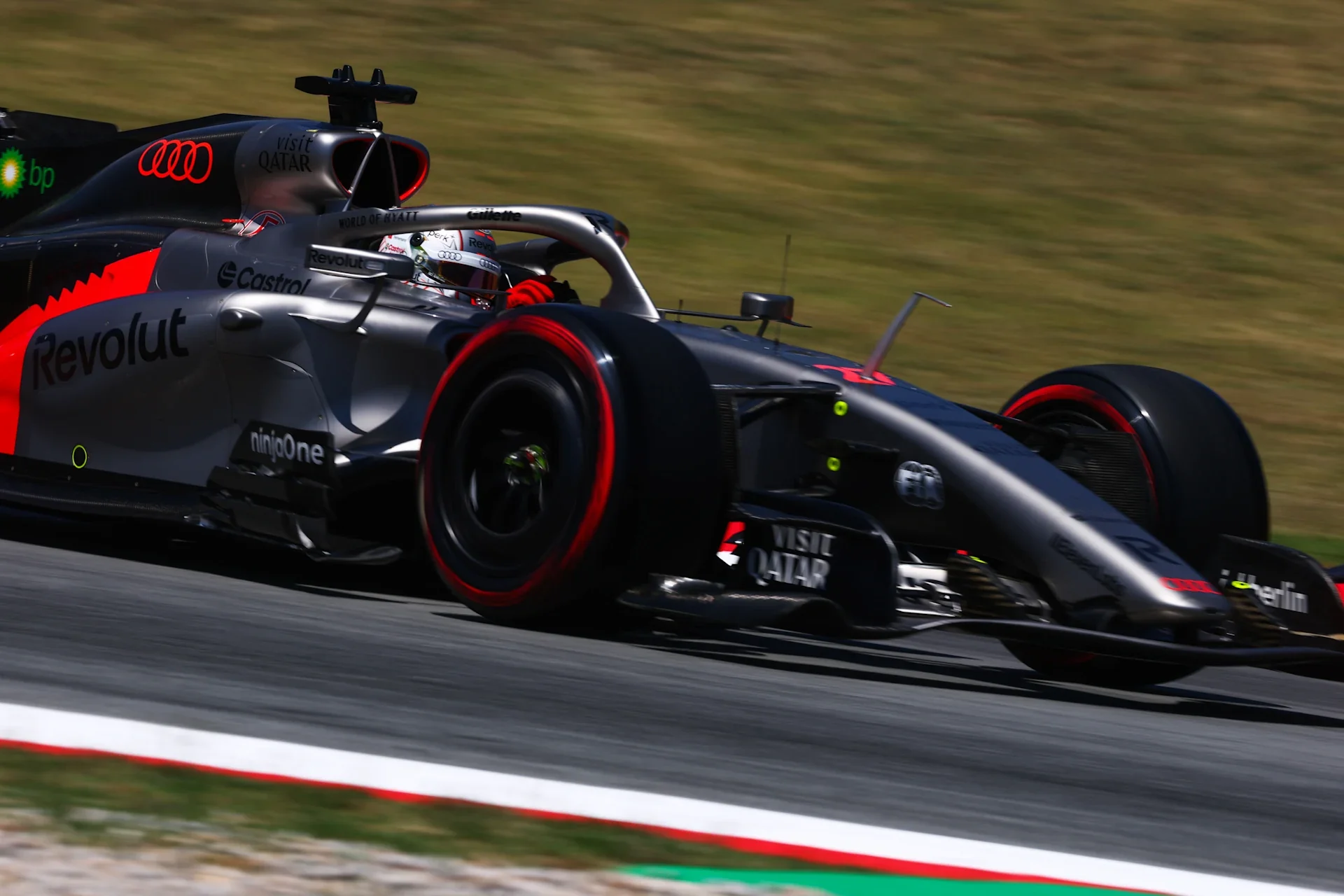
Lawson qualified eighth for Racing Bulls. Although his Q3 time was well behind the leading group, reaching the segment guaranteed a position ahead of every Q2 elimination. Hülkenberg placed Audi ninth after surviving a particularly narrow second-session cut.
Their results demonstrate the value of execution. Neither needed to challenge Russell's pole lap to earn a strong starting position; each had to deliver at the cut line when rivals could not. In a midfield decided by tenths, simply reaching Q3 changes strategic possibilities for the opening stint.
Lindblad Missed the Cut as Aston Martin Struggled
Lindblad was the first driver outside Q3. He missed Hülkenberg by less than a tenth and later reported that he had no deployment at Turn 1, a costly problem at the start of a lap. P11 remained a solid result but illustrated how a localized technical issue can decide the entire session.
The two Alpines occupied P13 and P14, Colapinto ahead of Gasly, while Sainz reached Q2 but ended P16. Williams team-mate Albon did not progress from Q1. Cadillac also lost both cars at the first cut, Perez ahead of Bottas.
Aston Martin had the hardest outcome. Stroll was 21st and Alonso 22nd at Alonso's home event. The official report noted that Stroll outqualified Alonso for the first time in 42 races. That statistic made the back-row lockout more striking, but the immediate competitive point was simpler: both cars lacked the pace to escape Q1.
What the Barcelona Result Said About the Grid
Qualifying produced a strategically varied opening order rather than consecutive team blocks at the front. Russell had Hamilton alongside, Antonelli directly behind and two different teams occupying row two. That diversity increased the possible launch and first-stint interactions.
Team-by-Team Starting Picture
Mercedes achieved the strongest combined result with first and third. Ferrari had a front-row car but Leclerc's crash left the second car tenth. McLaren occupied fourth and seventh, while Red Bull placed both cars together in fifth and sixth. The numbers showed Mercedes' one-lap advantage without suggesting an uncontested race.
Racing Bulls split its outcome between Lawson's eighth and Lindblad's eleventh. Audi likewise paired Hülkenberg's Q3 result with Bortoleto's P12. Alpine filled P13 and P14, Haas P15 and P17, and Williams P16 and P18. Cadillac's cars occupied P19 and P20 before Aston Martin's qualifying back row.
Qualifying Classification Versus the Official Grid
The official starting-grid document largely preserved the qualifying order, but it carried one important note. Alonso was required to start from the pit lane because his car was modified under parc fermé conditions and additional power-unit elements were used.
That meant describing Alonso simply as the P22 grid starter was incomplete. He had qualified 22nd, but the mandated pit-lane procedure governed his actual start. This is precisely why a completed-event recap should consult both official documents. The qualifying classification explains Saturday's pace; the grid records later technical and sporting consequences.
For future event checks, pair the qualifying results with the specific race weekend page. The first answers who was fastest; the second supplies the schedule, race context and links that prevent two Spanish events from being confused.
Loading comments…