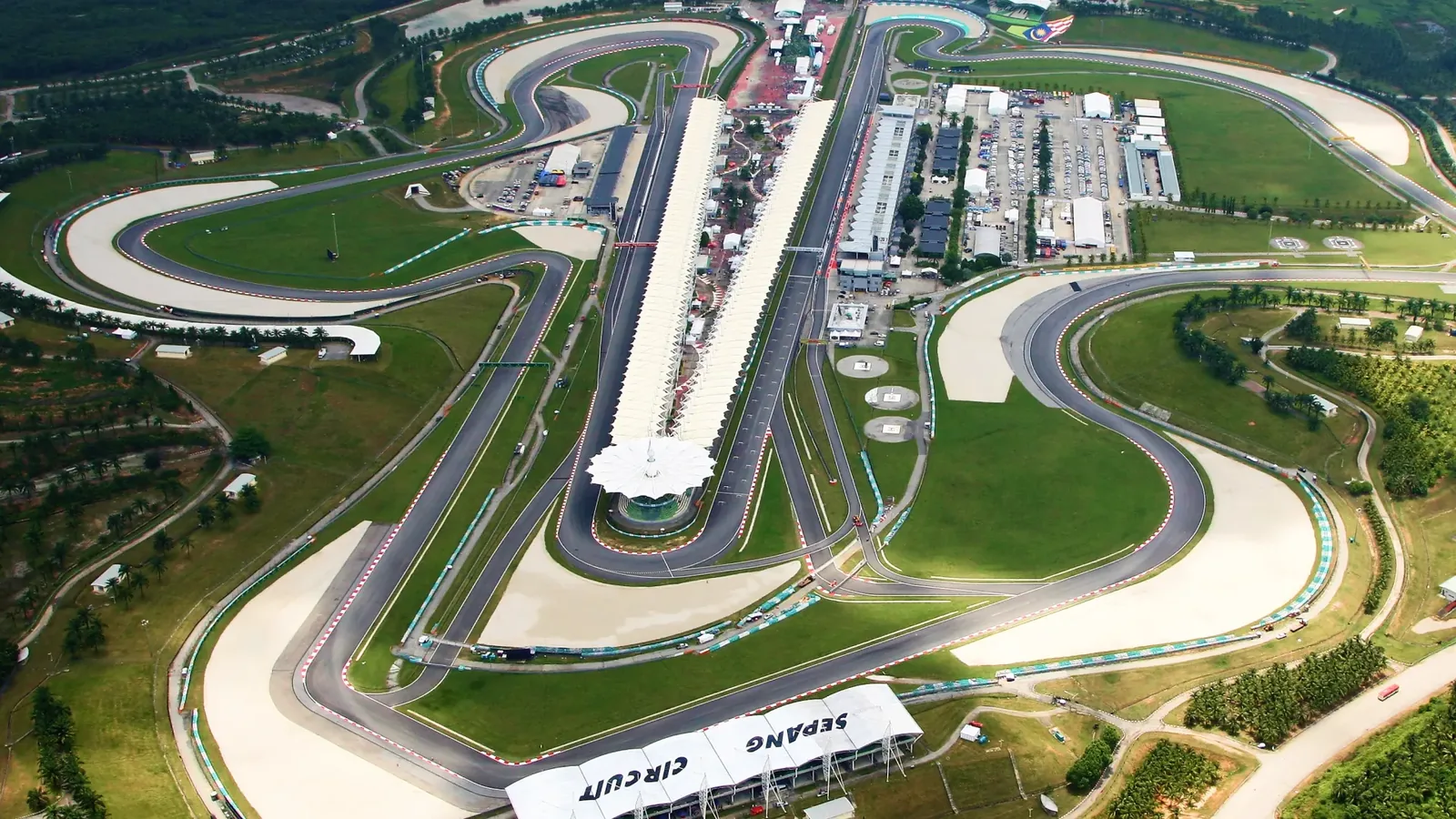
The 2026 Bahrain Grand Prix will be raced in Malaysia. Formula 1 and the FIA have placed the event at Sepang International Circuit for October 2-4, while retaining the official title “Formula 1 Gulf Air Bahrain Grand Prix in Malaysia.” It sounds contradictory because this is not a conventional revival of the Malaysian Grand Prix. It is the Bahrain championship event being preserved at a different host venue.
That distinction matters for everything from calendar listings to ticket searches. Fans are returning to the 5.543-kilometre Sepang circuit for the first F1 World Championship weekend there since 2017, but the event identity remains Bahrain’s. The race is scheduled for 56 laps and 310.418 kilometres, immediately before the Singapore Grand Prix weekend.
This guide gives the complete confirmed Sepang timetable in track time, UTC, the United Kingdom and the continental United States; explains exactly what Formula 1 and the FIA said about the unusual name; and separates confirmed arrangements from reasonable interpretation. Information is checked through September 14, 2026. No track result existed at that cutoff, so every competitive claim below is forward-looking context—not a fabricated outcome.
The Direct Answer: Bahrain’s 2026 F1 Race Is at Sepang
The event is physically taking place at Sepang International Circuit in Selangor, Malaysia, not at Bahrain International Circuit in Sakhir. Formula 1 lists it as Round 16 on October 2-4, between Azerbaijan and Singapore. It is a standard-format weekend: three practice sessions, Saturday qualifying and a Sunday Grand Prix. There is no Sprint.
Official event
Bahrain Grand Prix in Malaysia
Host venue
Sepang International Circuit
Race date
Sunday, October 4
Race distance
56 laps · 310.418 km
The cleanest way to understand the title is to separate the event from its venue. Formula 1 and the FIA said an agreement involving them and the governments of Bahrain and Malaysia preserved a Grand Prix that otherwise would not have happened. Malaysia supplies the host circuit; the Bahrain Grand Prix supplies the event identity. That is why the official branding combines both places.
This does mean Formula 1 racing returns to Sepang for the first time since the 2017 Malaysian Grand Prix. It does not mean the 2026 round is officially titled the Malaysian Grand Prix. That distinction is more than trivia: fans searching tickets, calendars or television listings should use the full Bahrain-in-Malaysia name, while anyone travelling must navigate to Sepang rather than Sakhir.
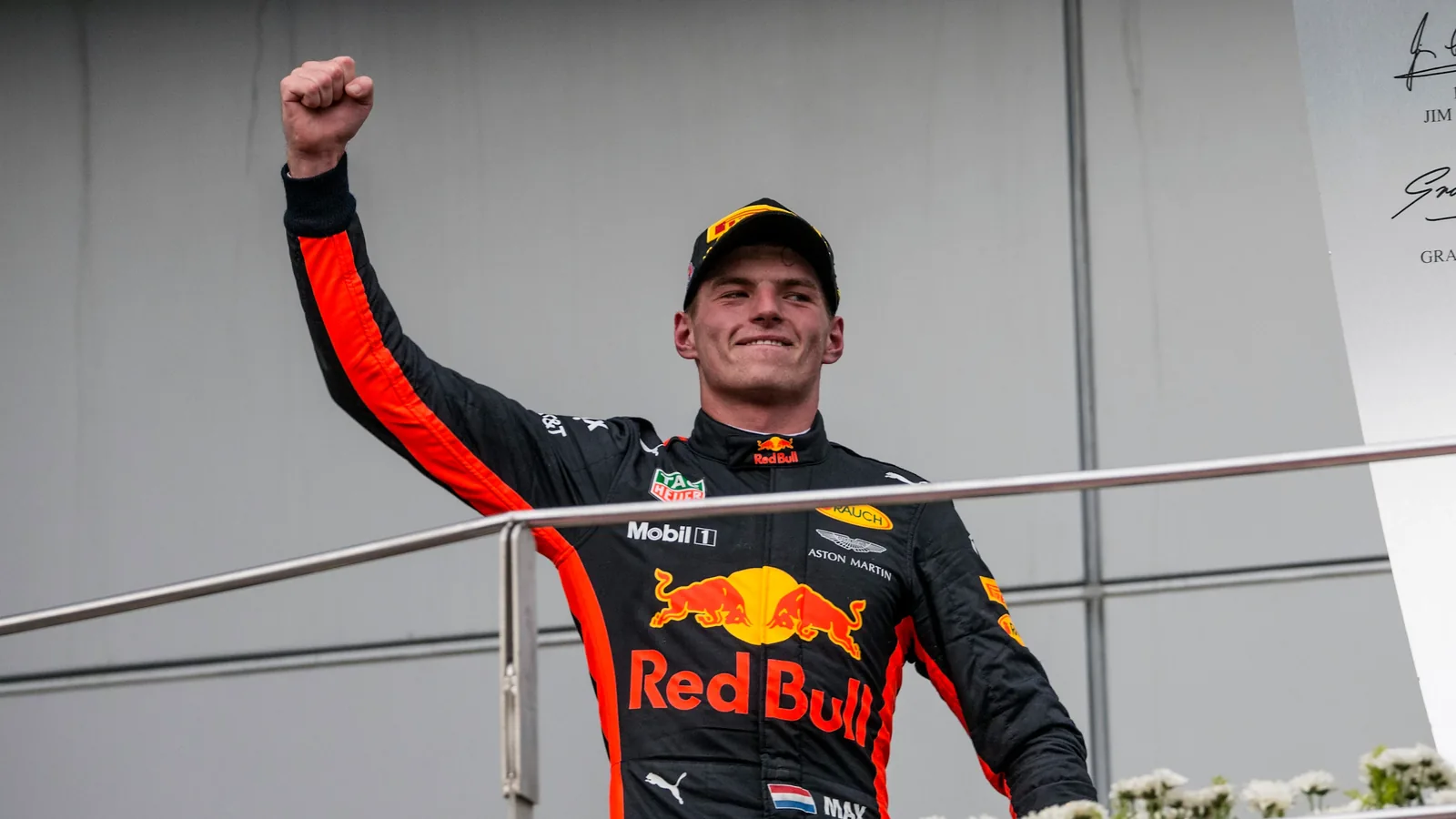
For live session status, local-time conversion and results once cars run, use the Bahrain Grand Prix in Malaysia event page. It is the safest reference if a session is delayed or the published timetable changes.
Complete Sepang Weekend Schedule and Race Times
Sepang runs a conventional Grand Prix timetable, not a Sprint programme. Friday has two practice hours, Saturday has FP3 and qualifying, and Sunday has the race. The table converts the same official start instant into five useful zones; it does not confuse a broadcaster’s pre-show with the moment cars enter the session.
| Session | Sepang (MYT) | UTC | UK (BST) | US Eastern (EDT) | US Central (CDT) | US Pacific (PDT) |
|---|---|---|---|---|---|---|
| FP1 | Fri Oct 2 · 12:30 PM | Fri · 04:30 | Fri · 5:30 AM | Fri · 12:30 AM | Thu · 11:30 PM | Thu · 9:30 PM |
| FP2 | Fri Oct 2 · 4:00 PM | Fri · 08:00 | Fri · 9:00 AM | Fri · 4:00 AM | Fri · 3:00 AM | Fri · 1:00 AM |
| FP3 | Sat Oct 3 · 12:30 PM | Sat · 04:30 | Sat · 5:30 AM | Sat · 12:30 AM | Fri · 11:30 PM | Fri · 9:30 PM |
| Qualifying | Sat Oct 3 · 4:00 PM | Sat · 08:00 | Sat · 9:00 AM | Sat · 4:00 AM | Sat · 3:00 AM | Sat · 1:00 AM |
| Race | Sun Oct 4 · 3:00 PM | Sun · 07:00 | Sun · 8:00 AM | Sun · 3:00 AM | Sun · 2:00 AM | Sun · 12:00 AM |
Sepang local time and UTC
Malaysia Time is UTC+8. FP1 and FP3 begin at 12:30 PM at the circuit, while FP2 and qualifying begin at 4:00 PM. Sunday’s 56-lap Grand Prix starts at 3:00 PM MYT, or 07:00 UTC. Formula 1 lists one-hour windows for each practice session and qualifying, but only a start time for the race. Do not plan a fixed finish: neutralisations, stoppages and the maximum race duration can alter it.
Use the live Sepang weekend schedule when the event approaches. Formula1.com can display either track time or a viewer-selected time, so check the label before copying a number into a calendar.
UK viewing times
The United Kingdom remains on British Summer Time during this weekend; clocks do not go back until October 25. That makes BST one hour ahead of UTC and seven hours behind Sepang. The race is at 8:00 AM BST on Sunday. Qualifying is the same clock time on Saturday, while FP1 and FP3 require 5:30 AM starts.
The label matters. A schedule that says “8:00 UK” is correct only if its October daylight-saving assumption is correct. Calling it GMT would move every session one hour late. Television build-up may begin before these times; the F1 TV schedule by country separates official on-track starts from broadcaster programming.
United States viewing times
Most US viewers are still on daylight time in early October. The race starts at 3:00 AM EDT, 2:00 AM CDT and midnight PDT at the beginning of Sunday. Qualifying is 4:00 AM Eastern, 3:00 AM Central and 1:00 AM Pacific on Saturday.
The date changes are the easy part to miss. FP1 lands Thursday night in Central and Pacific time even though it is already Friday at Sepang. FP3 also falls on Friday night in those two zones. Set reminders by the weekday shown in the table, not by assuming every Friday or Saturday session remains on the same US calendar date.
These daylight abbreviations do not cover every US location: most of Arizona and all of Hawaii do not observe the same seasonal clock pattern. Fans there should use the live timezone selector rather than treating “ET/CT/PT” as a nationwide conversion.
Why the Official Name Still Says Bahrain
The title makes more sense as a timeline than as a geography quiz. Bahrain’s original April round did not take place at Sakhir. Months later, Formula 1, the FIA and the Bahrain and Malaysia governments agreed on a way to stage that event at Sepang instead. Their own language describes Malaysia as the host and the Bahrain Grand Prix as the race being preserved.
What Formula 1 and the FIA actually confirmed
- March 14: the FIA announced that the Bahrain and Saudi Arabian Grands Prix would not take place in April because of the ongoing situation in the Middle East. It said no substitutions would be made in that April window and put safety and wellbeing at the centre of the decision.
- July 26: Formula 1 and the FIA announced Sepang as host for October 2-4. The release said the agreement preserved a Grand Prix that otherwise would not have happened and left the rest of the schedule unchanged.
- August 15 onward: Bahrain International Circuit and Sepang International Circuit launched ticket sales, while Formula1.com created the event hub and timetable under the combined Bahrain-in-Malaysia title.
The July announcement originally carried conditions covering final agreements, official sign-off and World Motor Sport Council approval. It would be misleading to erase that wording. Equally, it would be outdated to describe the race today as merely a hypothetical proposal: Formula 1 now lists the round, sessions and tickets. The 2026 F1 schedule places it between Azerbaijan and Singapore.
What the name does—and does not—prove
The published title proves three limited things: the event retains Bahrain Grand Prix identity, Gulf Air remains in the title, and Malaysia is its 2026 host. Official statements also emphasize Bahrain’s continued commitment and Malaysia’s support. They do not publish the fee split, promoter revenue, detailed contract clauses or a legal explanation of who owns which naming right. Claims about those private arrangements go beyond the evidence.
The most defensible reading is therefore practical: this is a Bahrain event staged at a Malaysian venue, with “in Malaysia” added so the location is unambiguous. Calling it the 2026 Malaysian Grand Prix would collapse that distinction and conflict with Formula 1’s own title. Saying “F1 returns to Malaysia” is accurate; saying “the Malaysian Grand Prix returns” is not the formal event description.
Formula 1 has used titles that do not map neatly onto borders before—the San Marino Grand Prix ran at Imola in Italy, while Luxembourg and Swiss Grand Prix names appeared at circuits in other countries. Those precedents show that a Grand Prix name is an event label, not always a location field. They do not reveal the terms of this particular Bahrain-Malaysia agreement, so the official 2026 releases remain the controlling evidence.
What Sepang Will Ask of the 2026 Cars
Sepang is not one-dimensional. A car has to spend little time fighting drag on the long straights, remain stable through major braking events, carry speed through flowing direction changes and still produce traction from slow corners. Add tropical thermal conditions and the circuit becomes a setup compromise rather than a simple low- or high-downforce test.
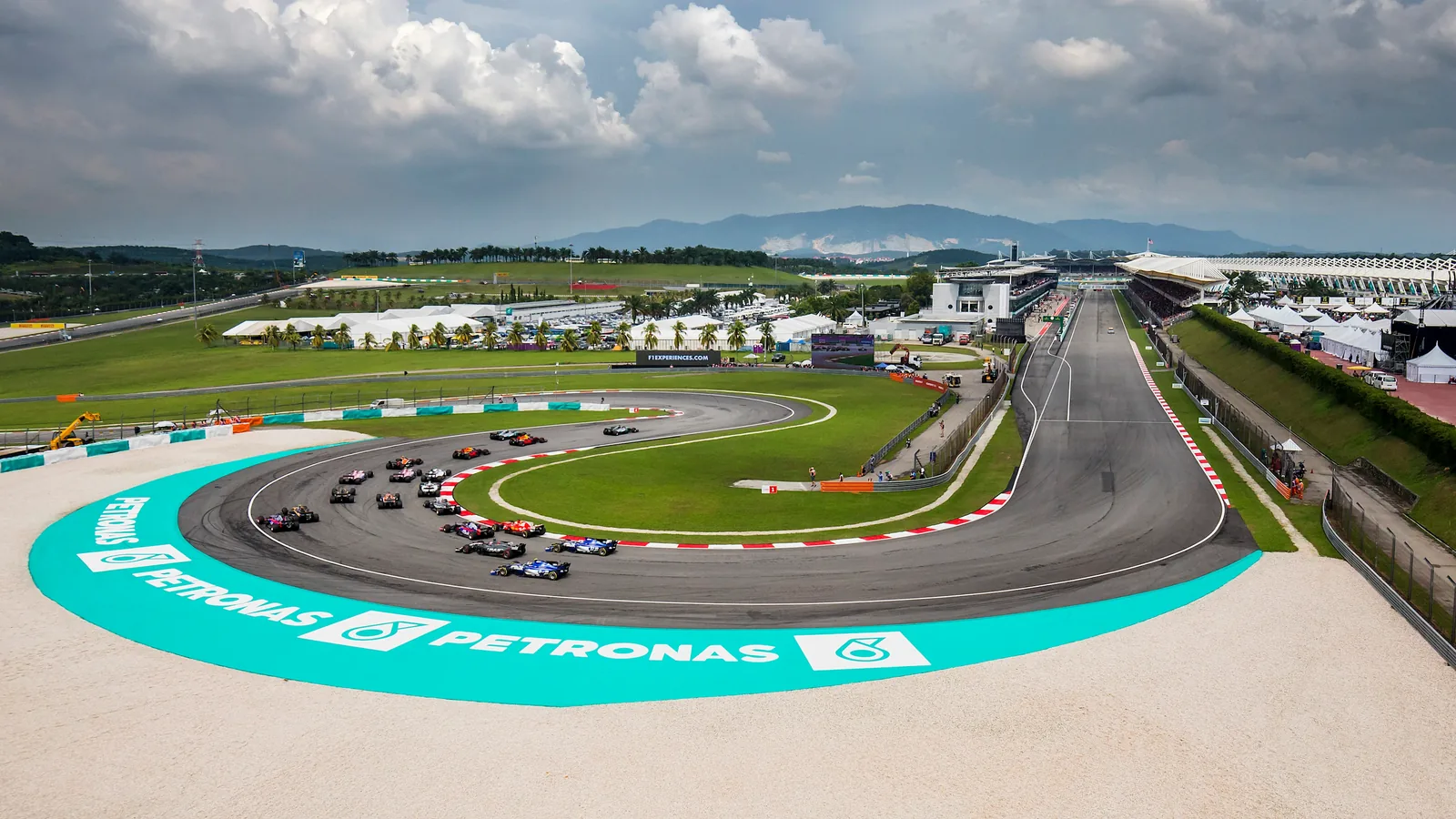
A fast, wide circuit with two defining straights
The 5.543-kilometre layout has 15 corners, eight straights and a published minimum width of 16 metres. That width gives drivers room to vary their approach, especially under braking, but asphalt alone does not create a pass. A following car still needs braking confidence, usable energy, front-end grip in dirty air and enough traction to finish the move.
The signature sequence begins before the final hairpin. Cars accelerate along the back straight toward Turn 15, brake into a corner that allows more than one approach, then launch immediately onto the main straight toward Turn 1. An attacker who dives too deep can surrender exit speed and face a counterattack seconds later. The defending driver is therefore managing two braking zones, not one isolated corner.
Elsewhere, the long Turns 5 and 6 sweep rewards balance and driver commitment, while Turns 1-2, Turn 9 and Turn 15 put traction back into the equation. Teams cannot remove wing for the straights without considering what that costs through loaded corners. Nor should fans assume that a wide track guarantees easy overtaking; the 2026 cars’ actual ability to follow and deploy their passing tools will become visible only in practice.
History supplies context, not a prediction. The final Malaysian Grand Prix in 2017 ended with Max Verstappen winning from third, 12.770 seconds ahead of Lewis Hamilton. The new generation of cars and rules makes old lap times a poor forecast, but that result is a useful marker: this weekend ends a nine-year absence of F1 championship competition from Sepang.
Heat, humidity and rain can reshape the weekend
Formula 1’s own circuit guide flags heat, humidity and sudden downpours. METMalaysia adds the important calendar context: thunderstorms occur throughout the year but become more frequent during the October-November inter-monsoon phase, often developing in the afternoon or early evening over land. A 3:00 PM race sits inside that broad climatological window. It is still not evidence that this particular Sunday will be wet.
In dry heat, teams need enough cooling margin for the power unit, brakes and cockpit environment. Opening cooling can carry an aerodynamic cost, so engineers must weigh protection against performance rather than simply choosing “maximum cooling.” The fast corners also feed sustained energy into the tyres, while the slower exits ask the rear axle to find traction. Until Pirelli and the teams publish event data, claims about exact degradation, graining or best compounds would be guesswork.
If rain arrives, the important moment is the crossover—not the first visible drop. Track temperature, standing water, visibility, drainage and the expected life of the shower all affect whether slicks, intermediates or full wets are appropriate. Conditions can also differ around a long lap. Fans should watch sector reports and radar, while teams balance the lap time lost on the wrong tyre against the pit loss required to change it.
Why the Singapore Back-to-Back Matters
The Sepang race does not stand alone on the 2026 calendar. Formula 1 races in Malaysia on Sunday, October 4, then moves directly to Singapore for the October 9–11 weekend. Both countries use UTC+8, so drivers, teams and travelling supporters avoid the body-clock reset that can make some consecutive races especially punishing. That is the helpful part of this regional pairing; it should not be confused with an easy week.
Cars, garage equipment and working areas still have to be packed after the Malaysian race and made operational for the next event on a compressed timetable. The confirmed dates support that general conclusion, although the public calendar does not reveal each team's freight route or working schedule. For a fan attending both races, the practical lesson is similar: build recovery and transfer time into the plan instead of treating Monday through Thursday as four free sightseeing days.
The sporting transition may be more important than the map suggests. Sepang is a wide, permanent circuit with long straights, fast loaded corners and three practice sessions. Singapore is a temporary 19-corner street track bordered by walls and raced at night. Its 2026 programme is also a Sprint weekend: after a single Friday practice, cars enter Sprint Qualifying. Teams therefore go from a conventional weekend with time to test several directions to one where the initial setup must be credible almost immediately.
That does not mean setup is literally locked when the trucks leave Sepang, or that one circuit automatically predicts form at the other. It means the lessons have to be filtered carefully. Cooling performance and driver acclimatisation to humidity may carry useful context, but a balance that works through Sepang's sweeping Turns 5 and 6 cannot simply be transferred to a slower, bumpier and barrier-lined street circuit.
Singapore's official schedule places Sprint Qualifying at 8:30 PM Friday, the Sprint at 5:00 PM Saturday, Grand Prix qualifying at 9:00 PM Saturday and the race at 8:00 PM Sunday. Readers planning the double-header can use our 2026 Singapore Grand Prix page as the next calendar checkpoint. Sepang starts the two-week test; Singapore immediately asks for a different car, rhythm and operating routine.
What Fans Should Check Before the Weekend
The unusual event name makes source-checking especially important. Begin with our live 2026 Bahrain Grand Prix in Malaysia event page and Formula 1's official event hub. Confirm that every session is displayed in the time zone you intend to use; Sepang local time is UTC+8, while device and broadcaster listings may convert automatically.
- Tickets: buy through a seller identified by the event organizers and recheck the live inventory. The official overview already shows some areas sold out, proving that an older screenshot is not a guarantee. Read the conditions for the chosen area, child admission and attendee identification before paying.
- Currency: the organizer says transactions are processed in Bahraini dinars at the prevailing exchange rate. A displayed dollar or ringgit figure may therefore differ from the final card charge after conversion and issuer fees.
- Circuit access: wait for the latest official instructions on gates, transport, parking and prohibited items. Save the ticket offline, download the current circuit map and allow a generous arrival buffer; do not assume procedures from Sepang's last F1 race in 2017 still apply.
- Weather: check METMalaysia and organizer notices close to each session. Seasonal thunderstorm climatology is a planning prompt, not a forecast. Pack permitted sun and rain protection and expect outdoor hillstand conditions to differ from covered seating.
- Viewing: broadcast rights and streaming products differ by country. Our current F1 TV schedule is the appropriate place to confirm a legal local channel or service rather than relying on an old social post.
The central facts are firm: Sepang hosts on October 2–4, the official title retains Bahrain, qualifying starts at 4:00 PM local on Saturday and the race starts at 3:00 PM local on Sunday. Ticket status, access arrangements, weather and broadcast placement can still change. Treat those as live checks and this rare return to Sepang becomes much easier to plan accurately.
Loading comments…